

In brief
Home hearing care in Wolverhampton offers a practical and reassuring alternative to clinic-based services.It brings hearing tests, hearing aid support and earwax removal into a setting that feels familiar.
Key takeaways
- A home earwax visit starts with an examination of both ears.
- Microsuction is provided only when it is suitable for the person and the ear.
- Sudden hearing loss, severe pain, discharge or significant dizziness need medical advice.
How this guide answers your question
Use these points to move from the concern you noticed to a sensible next step.
What Is the Difference Between Earwax Care and a Hearing Assessment?Hearing care is often associated with clinics.
Appointments, waiting rooms and travel are usually seen as part of the process. For many people, this has simply been accepted as the only way to access support.
However, hearing care does not have to take place in a clinical setting.
Across Wolverhampton, more patients are choosing to receive support at home. This approach brings hearing tests, hearing aids and earwax removal into a familiar environment, making the experience more comfortable and easier to manage.
The purpose remains the same.
To understand hearing clearly and to provide appropriate support.
What changes is how that care is delivered.
What Is Home Hearing Care?

Home hearing care is a service where a qualified audiologist provides assessment and support in your own home.
It includes hearing tests, earwax removal and hearing aid fitting, all carried out using professional equipment designed for home use.
The standard of care remains consistent with clinical practice.
The difference is the environment.
At home, the process feels more personal. There is more time to understand each step and less pressure to move quickly through the appointment.
This creates space for clear communication and considered decision-making.
Why Home-Based Hearing Care Is Growing in Wolverhampton
The shift towards home hearing care is gradual but clear.
For many residents in Wolverhampton, practical considerations play an important role.
Travel can be tiring, particularly for older adults or those with mobility concerns. Public transport and parking can add unnecessary stress to what should be a straightforward appointment.
There is also a preference for a more familiar setting.
Being at home allows patients to feel at ease. It removes the need to adjust to a clinical environment and often makes conversations easier to follow.
Family members can be present without difficulty, which helps provide reassurance and support.
These factors combine to create a more accessible and comfortable approach to hearing care.
Hearing Tests at Home in Wolverhampton
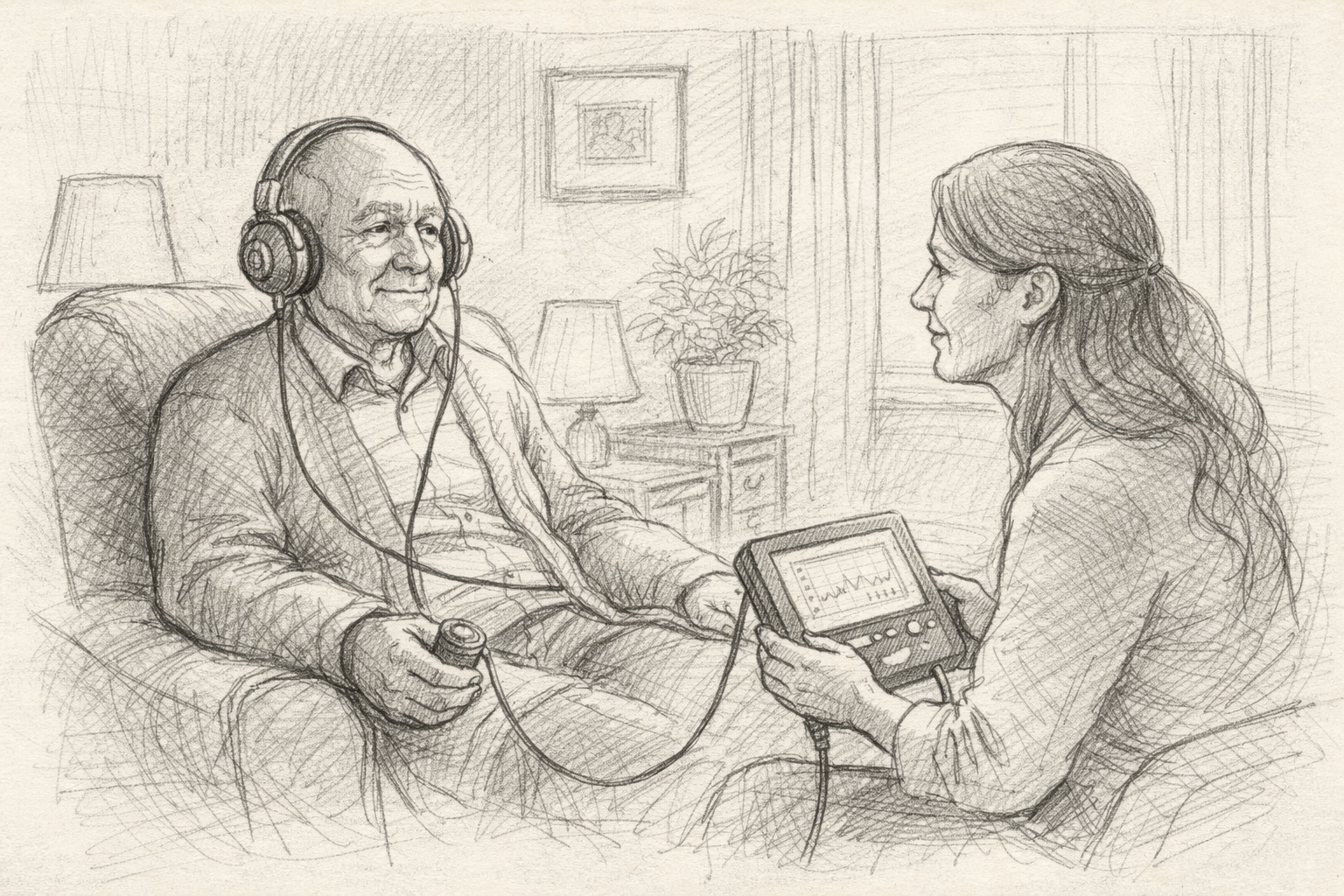
A hearing test carried out at home follows a structured process.
It begins with a conversation.
The audiologist will take time to understand your experience. This may include how you hear in everyday situations, whether conversations feel different and how your hearing has changed over time.
This context is important.
It helps ensure that the assessment reflects your daily life rather than just a set of measurements.
The test itself is carried out using portable equipment.
You will listen to a range of sounds through headphones and respond when you hear them. Speech-based sounds may also be used to understand clarity.
The process is simple and does not cause discomfort.
Once the assessment is complete, the results are explained clearly.
There is time to ask questions and to understand what the findings mean.
Earwax Removal at Home
Earwax is a common cause of hearing difficulty.
In many cases, a feeling of blockage or reduced clarity is linked to wax build-up rather than a change in hearing itself.
At home, earwax removal can be carried out safely using modern techniques such as microsuction.
This method allows wax to be removed gently and with precision.
The process begins with an examination of the ear to confirm the presence of wax and to assess its position.
If removal is appropriate, it is carried out carefully and at a comfortable pace.
Most patients find the process straightforward.
In many cases, hearing improves immediately after removal.
Providing this service at home removes the need to attend a clinic and allows the process to take place in a calm and familiar setting.
Hearing Aid Support at Home
When hearing changes are identified, hearing aids may be recommended.
Home hearing care allows this step to be handled in a more personal way.
The audiologist can explain how hearing aids work and what to expect from using them. This is done in clear and simple terms, without pressure.
If you choose to proceed, the fitting can take place during a home visit.
This allows the devices to be adjusted based on your real environment.
Sounds such as conversation, television and everyday background noise can all be considered during the fitting process.
This makes the adjustments more relevant and practical.
Support continues after fitting.
Follow-up visits allow any changes to be made as needed, ensuring that the hearing aids remain comfortable and effective.
A More Natural Way to Understand Hearing

One of the advantages of home hearing care is that it reflects how hearing is experienced in daily life.
Clinics provide controlled environments, which are useful for measurement.
However, hearing is not experienced in isolation.
It is shaped by surroundings, routines and interactions.
At home, these factors are present.
This allows the audiologist to understand not just how you hear, but how hearing affects your everyday life.
This leads to more meaningful support.
Supporting Independence Through Home Care
Maintaining independence is important.
Hearing plays a role in this.
Clear communication supports confidence. It allows people to stay connected with family, friends and the wider community.
Home hearing care supports independence by making services easier to access.
There is no need to rely on travel arrangements or external support to attend appointments.
Care is delivered in a way that fits into daily life.
This approach respects both comfort and dignity.
The Role of Family in Home Hearing Care
Family involvement can be valuable.
When appointments take place at home, it is easier for family members to be present.
This allows them to understand the process and to support communication.
It also helps ensure that any advice or recommendations are clearly understood.
For many patients, this shared understanding provides reassurance.
Addressing Concerns About Home Hearing Care

It is natural to have questions about receiving care at home.
Some people wonder whether the quality of assessment is the same as in a clinic.
Modern portable equipment allows hearing tests, ear examinations and hearing aid fittings to be carried out accurately and safely.
Others may feel uncertain about having medical equipment in their home.
In practice, the setup is simple and unobtrusive.
The focus remains on comfort and clarity.
There may also be concerns about what happens if hearing changes are identified.
Understanding hearing does not mean committing to treatment.
It provides information.
Decisions can then be made at a pace that feels appropriate.
When to Consider Home Hearing Care

Hearing care at home can be considered at any stage.
It may be helpful when hearing changes are first noticed.
It may also be useful when existing hearing aids need adjustment or review.
Earwax removal may be required if there is a feeling of blockage or reduced clarity.
The key point is that support is available when needed, without the need to travel.
A Service Designed Around You
Home hearing care is not defined by location alone.
It is defined by approach.
The focus is on understanding your hearing, providing clear information and supporting you in a way that feels comfortable.
The pace is set by your needs.
The environment is familiar.
The process is straightforward.
Frequently Asked Questions
Is home hearing care available across Wolverhampton?
Most providers offer services across Wolverhampton and surrounding areas.
Can all services be provided at home?
Hearing tests, earwax removal and hearing aid fitting can all be carried out during home visits.
Is the equipment the same as in clinics?
Portable equipment is designed to provide accurate and reliable results.
How long does an appointment take?
Appointments usually last between one and two hours, depending on what is required.
Can family members attend?
Yes, and many patients find this helpful.
Is follow-up support available?
Ongoing support is typically provided to ensure that hearing care remains effective.
Final Thoughts
Home hearing care in Wolverhampton offers a practical and reassuring alternative to clinic-based services.
It brings hearing tests, hearing aid support and earwax removal into a setting that feels familiar.
The process is clear.
The pace is calm.
The focus is on understanding.
Hearing should support daily life without creating difficulty.
When it changes, it is worth understanding why and how it can be supported.
Not through urgency.
But through care that is considered, accessible and delivered in the place where it matters most.
For appointment information rather than general guidance, see hearing tests in Wolverhampton. Check current postcode coverage before arranging a visit.
Earwax symptoms and sensible next steps
Symptoms can have more than one cause. This table helps readers distinguish routine earwax concerns from changes that need medical advice.
| What you notice | What it may mean | A sensible next step |
|---|---|---|
| Gradually muffled or blocked hearing | Earwax may be contributing | Arrange an ear examination before choosing treatment |
| Hearing aids sound quieter or whistle | Wax, fit or device maintenance may be involved | Check the device and arrange an ear check if it continues |
| Sudden loss, severe pain, discharge or significant dizziness | This is not a routine wax-removal presentation | Seek prompt medical advice |
Need your ears checked at home?
See how Hazelwood examines both ears and provides microsuction where suitable.
View Wolverhampton earwax care → Localised Hearing Care
 Localised Hearing Care
 Localised Hearing Care