

Most people think earwax affects only one thing.
Hearing.
When hearing becomes muffled or blocked, earwax is often one of the first possibilities that comes to mind.
But what many people don't realise is that, in some situations, impacted earwax may affect much more than hearing alone.
For some people, it can contribute to dizziness, feelings of imbalance and an increased risk of falls.
These symptoms are not always caused by earwax, and dizziness should never automatically be assumed to be the result of wax build-up. There are many possible medical causes of dizziness, some of which require urgent medical assessment.
However, when significant earwax build-up is present, it can sometimes affect balance or worsen existing balance problems. This is one reason professional assessment is so important.
Recently, we met a patient whose experience highlights exactly why ear health should never be ignored.
With her permission, we're sharing part of her story to help others recognise the signs early.
It didn't begin with a dramatic emergency.
Like many of our patients, the changes happened slowly.
Her hearing wasn't as clear as it used to be.
She occasionally felt slightly unsteady.
At times, she described feeling "off balance."
These symptoms didn't seem connected.
Like many people, she assumed they were simply part of getting older.
Unfortunately, things became worse.
Eventually she suffered a serious fall.
The injuries were significant.
She fractured her arm.
She also broke her leg.
When we later assessed her ears, there was a significant build-up of earwax.
While it would not be appropriate to say earwax alone caused the fall, her blocked ears had affected her balance, removing one important source of sensory information the body uses to stay steady.
Her story is an important reminder that hearing and balance are more closely linked than many people realise.
Most people associate the ears with hearing.
In reality, the ears perform another vital role.
Inside the inner ear sits the vestibular system.
This complex structure constantly provides information to the brain about head movement and body position.
Your brain combines information from:
Your eyes
Your muscles and joints
Your vestibular system
Together, these systems help you remain balanced while walking, standing and changing direction.
When one part of this system is disturbed, balance may become more difficult.
Although impacted earwax does not affect the inner ear directly, a blocked ear can sometimes create pressure, altered hearing and sensations that contribute to dizziness or imbalance in certain people.
This is why hearing problems should never simply be ignored.
%20(1).png)
Many people expect earwax to cause hearing loss alone.
In reality, symptoms vary considerably.
Some people notice reduced hearing.
Others experience a feeling of fullness inside the ear.
Some describe sounds becoming muffled or distant.
Others notice ringing in the ears.
In certain cases, people may experience dizziness or feel less steady on their feet.
Some patients describe a sensation similar to walking on uneven ground, even when standing on a flat surface.
Not everyone experiences every symptom.
Some people have significant earwax with very few symptoms at all.
Others notice even relatively small blockages.
This is why professional examination is important.
Balance naturally becomes more challenging as we age.
Vision changes.
Muscle strength changes.
Reaction times slow.
If hearing also becomes reduced because of impacted earwax, everyday balance may become even more difficult.
For older adults, even a single fall can have life-changing consequences.
Recovery may take months.
Confidence can be affected.
Independence may decline.
That is why maintaining good hearing health is about much more than hearing conversations.
It is also about supporting confidence, mobility and quality of life.
Although earwax can sometimes contribute to dizziness, it is very important to understand that dizziness has many possible causes.
It may be related to:
Inner ear conditions
Low blood pressure
Medication side effects
Heart conditions
Neurological problems
Dehydration
Or other medical conditions.
If dizziness is sudden, severe, persistent or associated with symptoms such as weakness, chest pain, difficulty speaking or severe headache, urgent medical attention should always be sought.
Professional assessment helps determine whether earwax is part of the problem or whether further medical investigation is required.
Every appointment begins with a detailed examination of the ear canal.
Rather than assuming earwax is present, we carefully inspect the ears using specialist equipment.
This allows us to understand:
Whether wax is present.
How much is present.
Whether removal is appropriate.
If earwax removal is suitable, microsuction is often the preferred technique.
Microsuction allows wax to be removed carefully without using water, providing a controlled and precise method of treatment.
Many patients experiencing dizziness or balance concerns understandably feel less confident travelling.
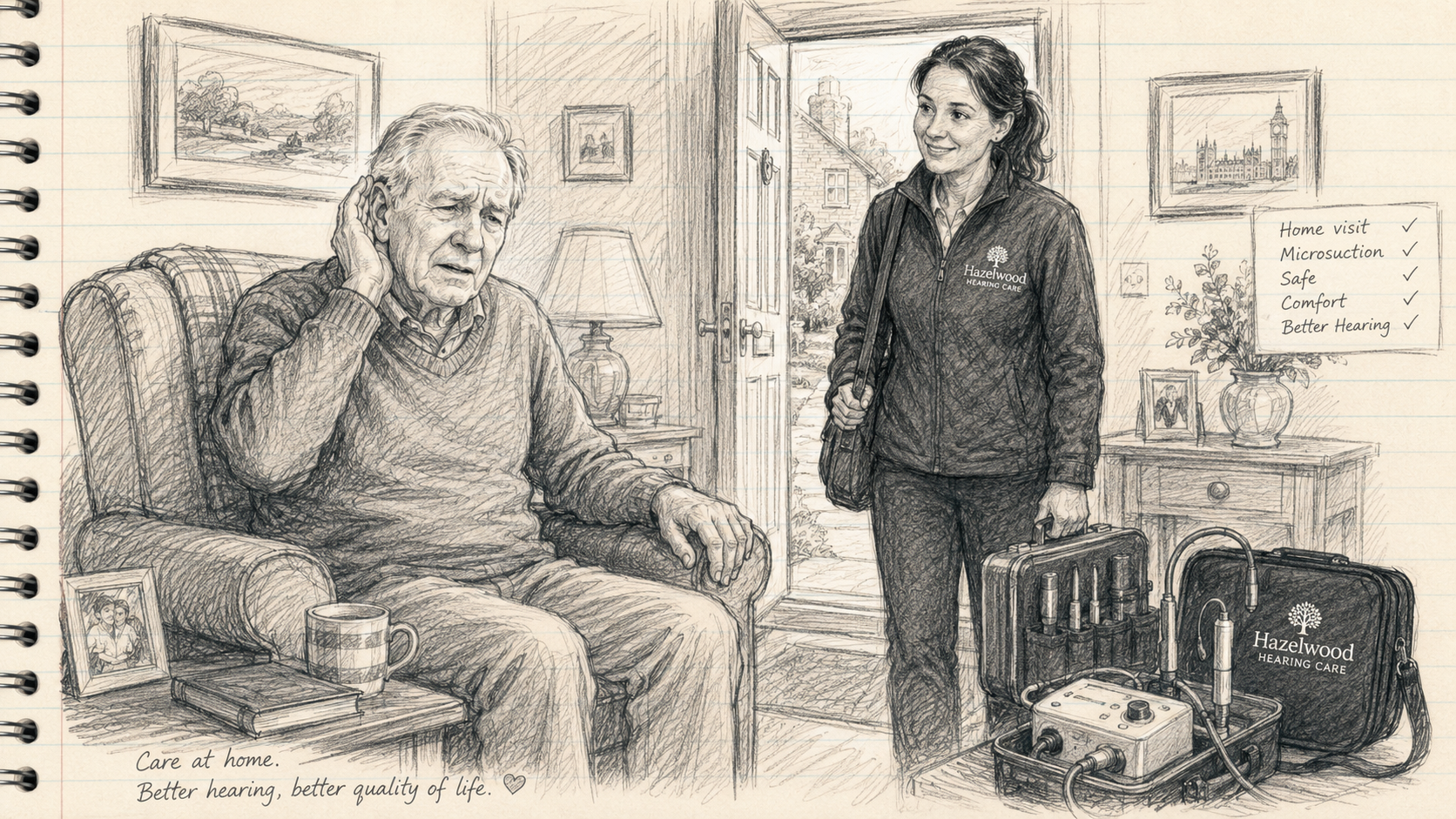
This is why home visit earwax removal has become increasingly popular.
Receiving professional care at home removes unnecessary travel and allows treatment to take place in familiar surroundings.
Appointments feel calmer.
Patients feel more relaxed.
Family members can also be present to provide reassurance and support.
Every patient is different.
Some notice immediate improvements in hearing clarity.
Others describe reduced feelings of pressure or fullness.
Where earwax has been contributing to balance or dizziness, some patients also report feeling steadier after treatment.
However, it is important to remember that not all dizziness is caused by earwax.
Professional assessment helps determine the most appropriate next step.
Healthy ears usually clean themselves naturally.
Most people do not need to remove earwax routinely.
Avoid inserting cotton buds or other objects into the ear.
These often push wax deeper rather than removing it.
If you notice changes in hearing, persistent blocked ears or recurring earwax problems, arranging a professional assessment is the safest approach.
Our patient's story is one we will never forget.
Her injuries were serious.
Thankfully, she gave us permission to share her experience so others might recognise the importance of looking after their hearing sooner.
Her message is simple.
Do not ignore changes in your hearing.
Do not assume dizziness is simply part of getting older.
Seek professional advice.
Sometimes the cause is more straightforward than expected.
Sometimes it is not.
Either way, understanding the cause is always the first step.
Yes. In some people, impacted earwax may contribute to dizziness or feelings of imbalance. However, dizziness has many possible causes, so professional assessment is important.
It can contribute to balance problems in some individuals, although balance issues should always be properly assessed because many medical conditions can produce similar symptoms.
If earwax contributes to dizziness or reduced balance, it may increase the likelihood of falling in some people. Falls are usually caused by multiple factors rather than one single issue.
It is generally best to avoid cotton buds or inserting objects into the ear. Professional assessment is the safest approach.
Yes. When carried out by a trained clinician, microsuction is a safe and widely used method of earwax removal.
Your ears do far more than help you hear.
They help you stay connected to the world around you.
They also play an important role in helping your body maintain balance.
If hearing becomes muffled, your ears feel blocked or you begin experiencing dizziness, do not ignore the change.
It may not be earwax.
But if it is, professional treatment can often provide straightforward relief.
As our patient's story reminds us, small symptoms should never be dismissed.
Sometimes taking action early can make all the difference.