

Hearing changes rarely happen all at once.
They tend to develop gradually, often over months or even years. Conversations may become slightly harder to follow. Background noise may feel more intrusive. Television volume may increase without much thought.
For many people in Coventry, recognising these changes is only the first step.
The next step, arranging a hearing test, is not always straightforward. Travelling to a clinic can feel inconvenient. Waiting rooms may feel unfamiliar. Appointments can feel rushed.
Home hearing tests offer a different approach.
They allow hearing to be assessed in a calm, familiar environment, without the need to travel or adjust to a clinical setting. For many patients, this creates a more comfortable and reassuring experience.
This guide explains how hearing tests at home in Coventry work, what to expect during a visit and how this approach supports clear, appropriate hearing care.
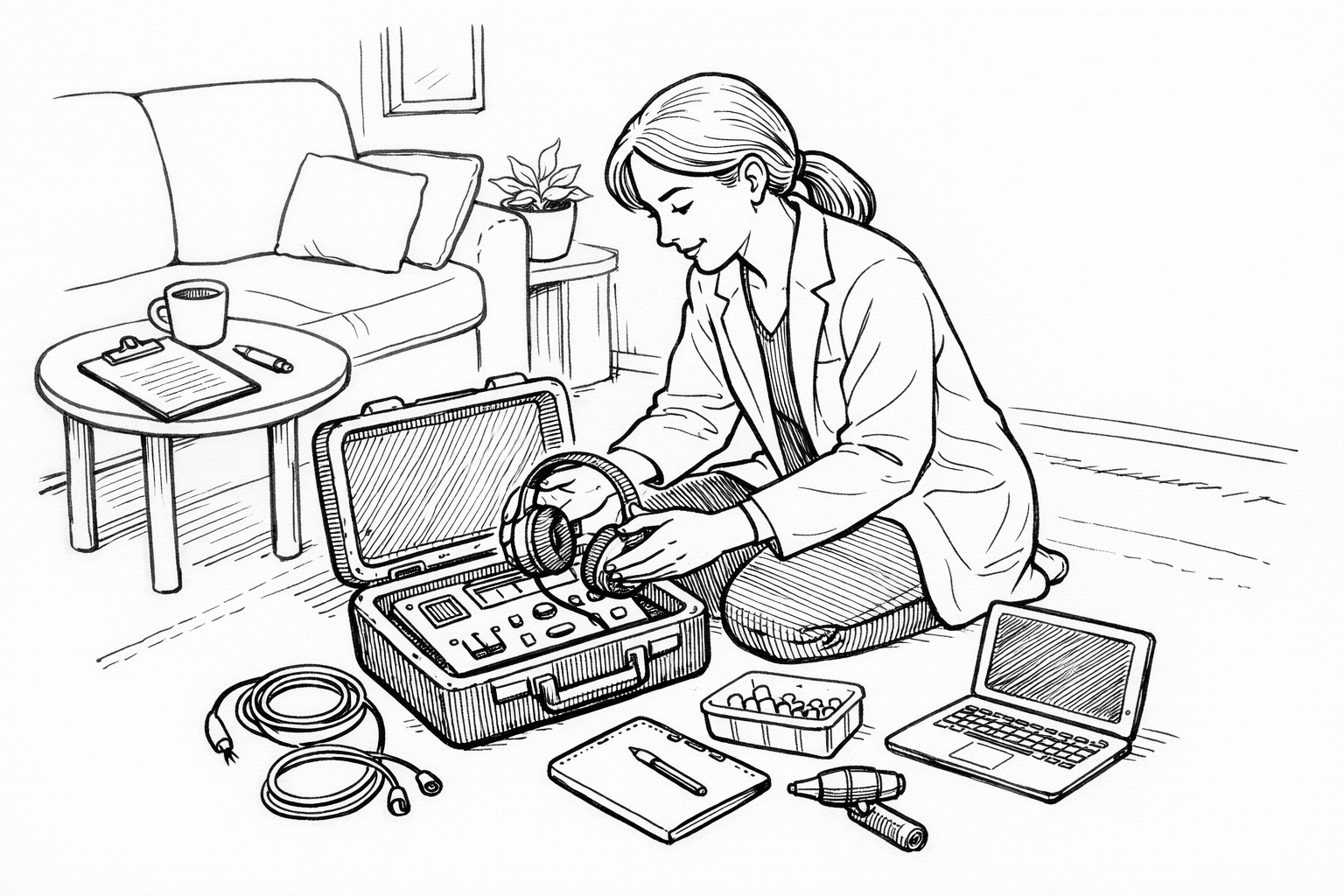
A home hearing test is a full hearing assessment carried out by a qualified audiologist in your own home.
It follows the same clinical principles as a clinic-based test, using portable equipment designed for accuracy and reliability. The purpose is to understand your hearing clearly and to identify whether any support may be helpful.
The difference lies in the setting.
At home, the environment is familiar. There is no need to travel. The pace of the appointment is more relaxed. This often allows for better communication and a clearer understanding of your hearing needs.

Across Coventry, more people are choosing home-based hearing care.
This change is not driven by convenience alone. It reflects a preference for a more comfortable and personalised experience.
Being at home removes many of the challenges associated with clinic visits. There is no need to arrange transport or navigate busy waiting areas. Appointments can be scheduled at a suitable time, allowing for a more relaxed approach.
For older adults, this can make a significant difference. For those with mobility concerns, it can make hearing care more accessible.
Families also benefit from being able to attend the appointment, helping to support communication and understanding.
Hearing is not experienced in isolation.
It is part of everyday life. Conversations, television, background noise and daily routines all play a role.
A home hearing test allows the audiologist to understand how you hear in your own environment. This provides valuable context that is not always available in a clinic setting.
The assessment becomes more than a measurement.
It becomes a reflection of how hearing affects daily living.

A home hearing test is structured, but it is not rushed.
It is designed to feel calm, clear and easy to follow.
The appointment begins with a discussion about your hearing.
You may be asked about situations where hearing feels more difficult, such as conversations in groups or listening to the television. You may also be asked about any changes you have noticed over time.
This conversation helps the audiologist understand your experience before any testing begins.
Before testing, the ears are examined.
This is a simple and gentle process.
The audiologist will check for earwax, blockages or any visible issues that could affect hearing. In many cases, earwax can cause symptoms that feel similar to hearing loss.
Identifying this early ensures that the correct approach is taken.
The hearing test itself involves listening to a series of sounds.
You will wear headphones and respond when you hear tones at different levels. Speech-based sounds may also be used to understand how clearly you hear words.
The process is straightforward and does not cause discomfort.
It is designed to provide a clear picture of your hearing.
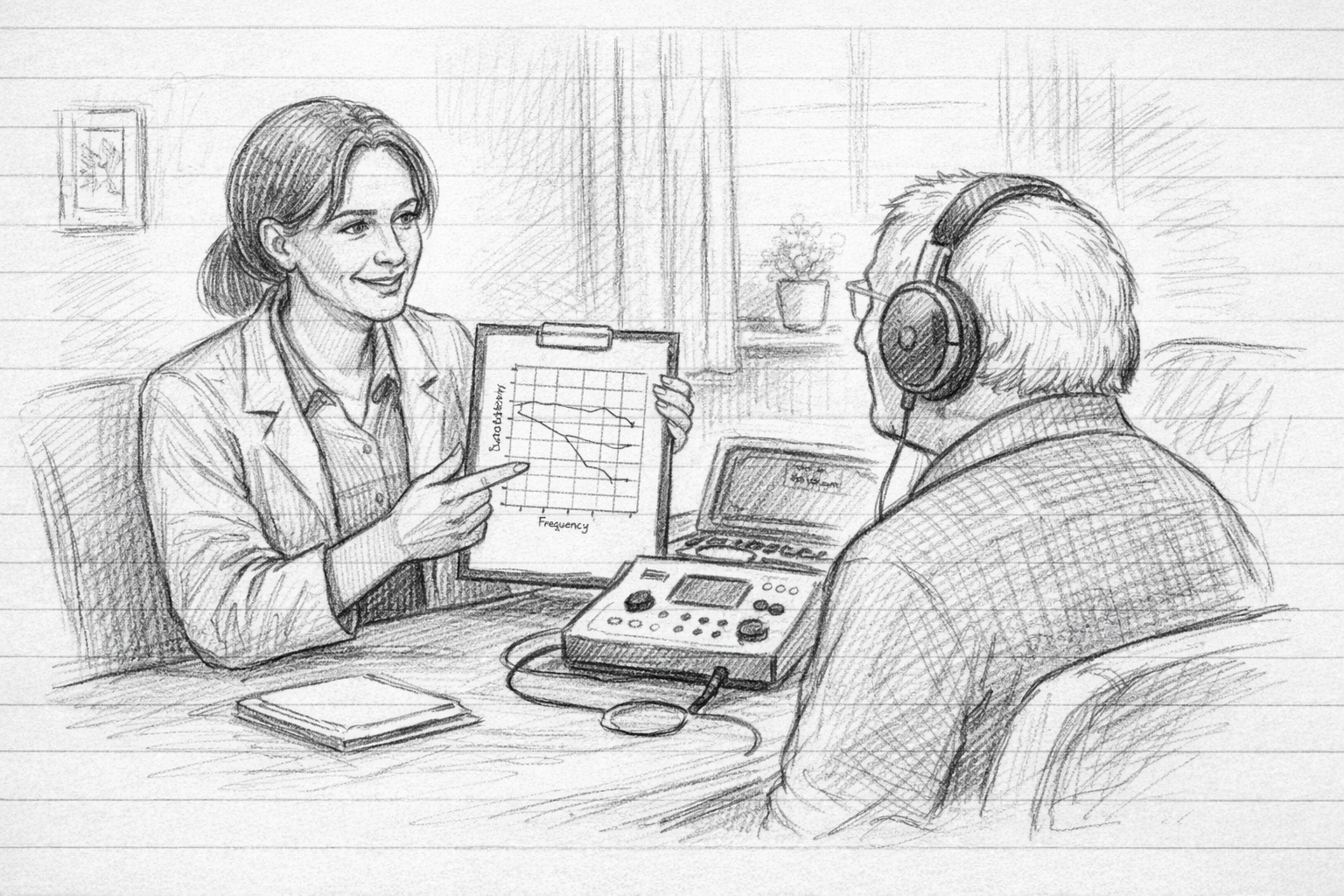
After the test, the results are explained in simple terms.
You will be able to understand whether your hearing is within a typical range or whether there are changes that may benefit from support.
There is no pressure to make immediate decisions.
The focus is on clarity and understanding.
One of the key differences between home and clinic appointments is time.
At home, there is space to pause, to ask questions and to reflect on the information provided.
This often leads to a better understanding of hearing and what the results mean in everyday life.
It also allows the audiologist to provide guidance that feels relevant and practical.
Earwax is a common cause of hearing difficulty.
In Coventry, many patients who arrange a home hearing test find that wax build-up is affecting their hearing.
This can create a feeling of blockage or reduced clarity.
When earwax is identified and removed, hearing often improves quickly.
This is why ear examination is always an important part of the process.
It ensures that simple causes are identified before further steps are considered.
If the assessment shows that hearing support may be helpful, this is discussed carefully.
The audiologist will explain the available options in a clear and balanced way. This may include hearing aids or other forms of support, depending on your needs.
There is no pressure to proceed.
The aim is to provide information so that you can make a decision at your own pace.
If hearing aids are considered, they can often be introduced during a home visit.
This allows adjustments to be made in your own environment, based on how you hear in everyday situations.
The process is gradual and focused on comfort.
Support continues beyond the initial fitting, ensuring that any adjustments can be made as needed.

Home hearing tests in Coventry are suitable for a wide range of people.
They are particularly helpful for older adults who prefer to remain in a familiar setting. They are also valuable for individuals who find travel difficult or tiring.
Care home residents can benefit from hearing assessments that take place without disrupting their routine.
Families often find reassurance in being present during the appointment, allowing them to support the process and understand the outcome.
However, home hearing care is not limited to specific groups.
Anyone who values a calm and practical approach to hearing care can benefit.
It is natural to have questions before arranging a hearing test.
Some people wonder whether a home hearing test is as accurate as one carried out in a clinic. Modern portable equipment provides reliable and clinically appropriate results.
Others are concerned about how the process will feel.
In most cases, patients describe the experience as calm and straightforward. The familiar environment helps reduce uncertainty and allows the appointment to feel more relaxed.
There is also concern about what happens if hearing changes are identified.
Understanding your hearing does not mean committing to treatment. It simply provides clarity and allows you to make informed decisions.
If you are arranging a hearing test for a family member, the approach should feel supportive rather than urgent.
It can help to present the test as a way to understand hearing more clearly, rather than as a response to a problem.
Being present during the appointment can provide reassurance and help with communication.
It also allows you to understand the results and any recommendations.
Hearing changes are often gradual, which means they can go unnoticed.
Early awareness allows small changes to be understood before they become more significant.
When hearing is supported appropriately, it helps maintain communication, confidence and social connection.
The aim is not to create concern.
It is to provide clarity at the right time.
A home hearing test usually takes between forty-five minutes and an hour and a half, depending on individual needs.
Yes. Portable equipment used by audiologists provides reliable and clinically appropriate results.
Not necessarily. The test is designed to understand your hearing, not to require treatment.
Yes. This is why the ears are examined before testing.
Most home hearing care providers cover Coventry and surrounding areas.
Yes. Many patients find it helpful to have a family member present during the appointment.

Hearing tests at home in Coventry offer a practical and reassuring way to understand your hearing.
They remove the need to travel. They provide a familiar setting. They allow time for clear and calm communication.
The process is simple.
The approach is considered.
The outcome is clarity.
Hearing should feel natural.
When it changes, even slightly, it is worth understanding why.
Not urgently.
Not with concern.
But with the right support, delivered in a way that feels comfortable and appropriate.