
Hearing Test
8 min read

Hearing Tests for Care Home Residents: A Clear and Reassuring Guide

March 26, 2026
Learn how hearing tests for care home residents work. A clear guide for families and staff on hearing care, assessments and support in the UK.
Written by
Rizwan Makda
Published on
March 26, 2026

Hearing plays a quiet but important role in daily life.

For care home residents, it supports:

  • Conversation with staff and family
  • Awareness of surroundings
  • Participation in activities
  • Overall wellbeing

Hearing changes are common with age, yet they are often overlooked in care settings. This is rarely intentional. It is simply because hearing loss develops gradually and can be difficult to recognise.

A structured hearing test provides clarity.

It helps ensure residents are supported with dignity, comfort and appropriate care  without unnecessary disruption.

This guide explains how hearing tests work in care homes, when they are needed, and how families and staff can approach hearing care calmly and confidently.
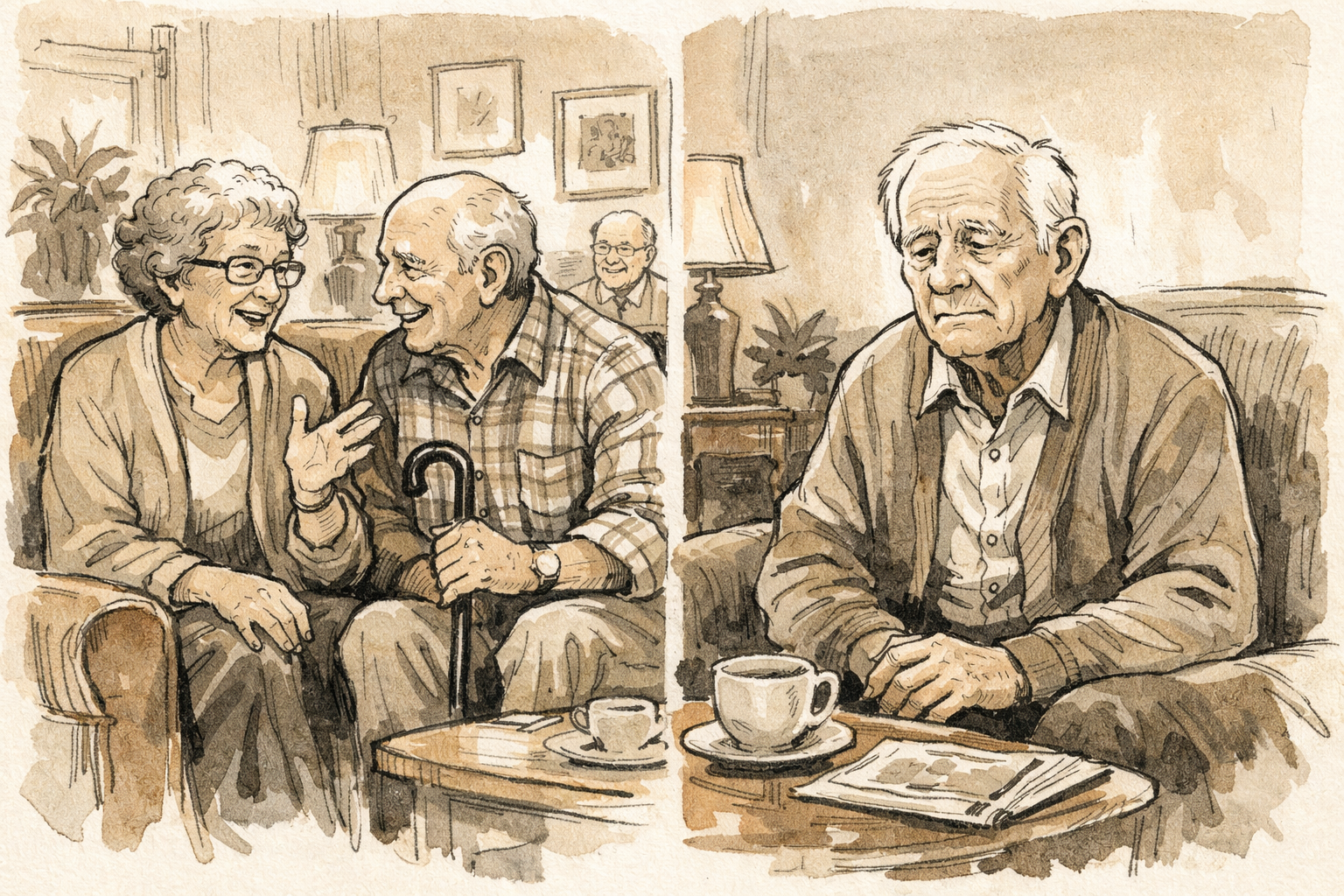
Why Hearing Care Matters in Care Homes

Hand-drawn illustration for Hazelwood showing elderly residents in a lounge—one engaged in conversation while another sits apart, emphasizing hearing clarity and social connection.

Hearing is closely linked to communication.

When hearing becomes reduced, even slightly, it can affect:

  • Understanding of speech
  • Response to instructions
  • Social interaction
  • Confidence

Over time, untreated hearing changes may lead to:

  • Withdrawal from group activities
  • Misunderstandings
  • Increased frustration
  • Reduced engagement

These changes are often mistaken for general ageing.

In reality, hearing may be a contributing factor.

A hearing test helps separate assumption from understanding.

Common Signs a Care Home Resident May Need a Hearing Test

Hand-drawn checklist illustration showing hearing difficulty signs—TV volume increase, leaning to listen, and confusion during conversation.

Hearing changes are not always obvious.

They often appear as small behavioural shifts.

Look for patterns such as:

  • Asking for repetition more frequently
  • Increasing television volume
  • Difficulty following group conversations
  • Appearing withdrawn or less engaged
  • Responding inappropriately to questions
  • Saying “I can hear you, but I can’t understand”
  • Complaints of ringing in the ears (tinnitus)

These signs do not confirm hearing loss, but they indicate that assessment would be helpful.

When Should a Hearing Test Be Arranged?

Hand-drawn horizontal calendar with circled appointment date and small ear icon, minimal pencil sketch style

A hearing test should be considered when:

  • Changes in communication are noticed
  • A resident expresses difficulty hearing
  • Staff observe repeated misunderstandings
  • Hearing has not been checked for several years
  • There is a history of hearing aid use

Routine hearing checks are also appropriate for older adults, even without obvious symptoms.

Regular monitoring supports early awareness.

What Is a Hearing Test in a Care Home Setting?

A hearing test in a care home is similar to one carried out in a clinic, but adapted for comfort and familiarity.

It is conducted:

  • In the resident’s room or a quiet space
  • Using portable equipment
  • At a pace suited to the individual

The goal is not speed.

It is clarity and comfort.

How a Hearing Test for Care Home Residents Works

The process is structured but gentle.

1. Initial Conversation

The audiologist begins with a simple discussion.

This may include:

  • Any hearing concerns
  • Observations from staff or family
  • Medical history (where relevant)

This helps guide the assessment.

2. Ear Examination

The ears are checked using a small light.

This allows the audiologist to identify:

  • Earwax build-up
  • Signs of irritation or blockage

If earwax is present, it may need to be addressed before testing.

3. Hearing Assessment

The resident listens to a series of sounds through headphones.

This includes:

  • Different tones at varying volumes
  • Speech-based tests to assess clarity

The process is calm and non-invasive.

There is no discomfort.

4. Results Explained Clearly

The audiologist explains:

  • What the results show
  • Whether hearing is within normal range
  • If support or monitoring is recommended

Information is shared in a clear, reassuring way.

Benefits of Hearing Tests for Care Home Residents

Hand-drawn illustration of an elderly resident smiling and engaging in conversation, showing improved hearing and social connection.

A hearing assessment offers practical benefits.

Improved Communication

Residents are better able to:

  • Understand staff
  • Engage with family
  • Participate in conversations
Increased Confidence

Clear hearing reduces uncertainty.

This often leads to:

  • Greater social involvement
  • Reduced frustration
  • Improved mood
Better Daily Care

Staff can communicate more effectively.

This supports:

  • Personal care routines
  • Medication understanding
  • Safety awareness
Early Identification of Issues

Hearing tests can identify:

  • Gradual hearing loss
  • Earwax blockages
  • Changes over time

Early awareness allows appropriate support.

The Role of Earwax in Hearing Difficulties

Earwax is a common and often overlooked factor.

In older adults, it can:

  • Build up more easily
  • Become harder in consistency
  • Block sound entering the ear

Signs of earwax-related hearing issues include:

  • Sudden reduction in hearing
  • Feeling of fullness in the ear
  • Fluctuating hearing clarity

In many cases, removing earwax restores hearing quickly.

This is why ear examination is an important part of assessment.

Hearing Aids in Care Home Settings

If hearing loss is identified, hearing aids may be recommended.

It is important to understand:

  • Hearing aids are not always necessary
  • Recommendations are based on individual needs
  • Modern devices are small and adaptable

For care home residents, the focus is on:

  • Comfort
  • Ease of use
  • Clear benefit

Support is provided to ensure devices are used correctly and maintained properly.
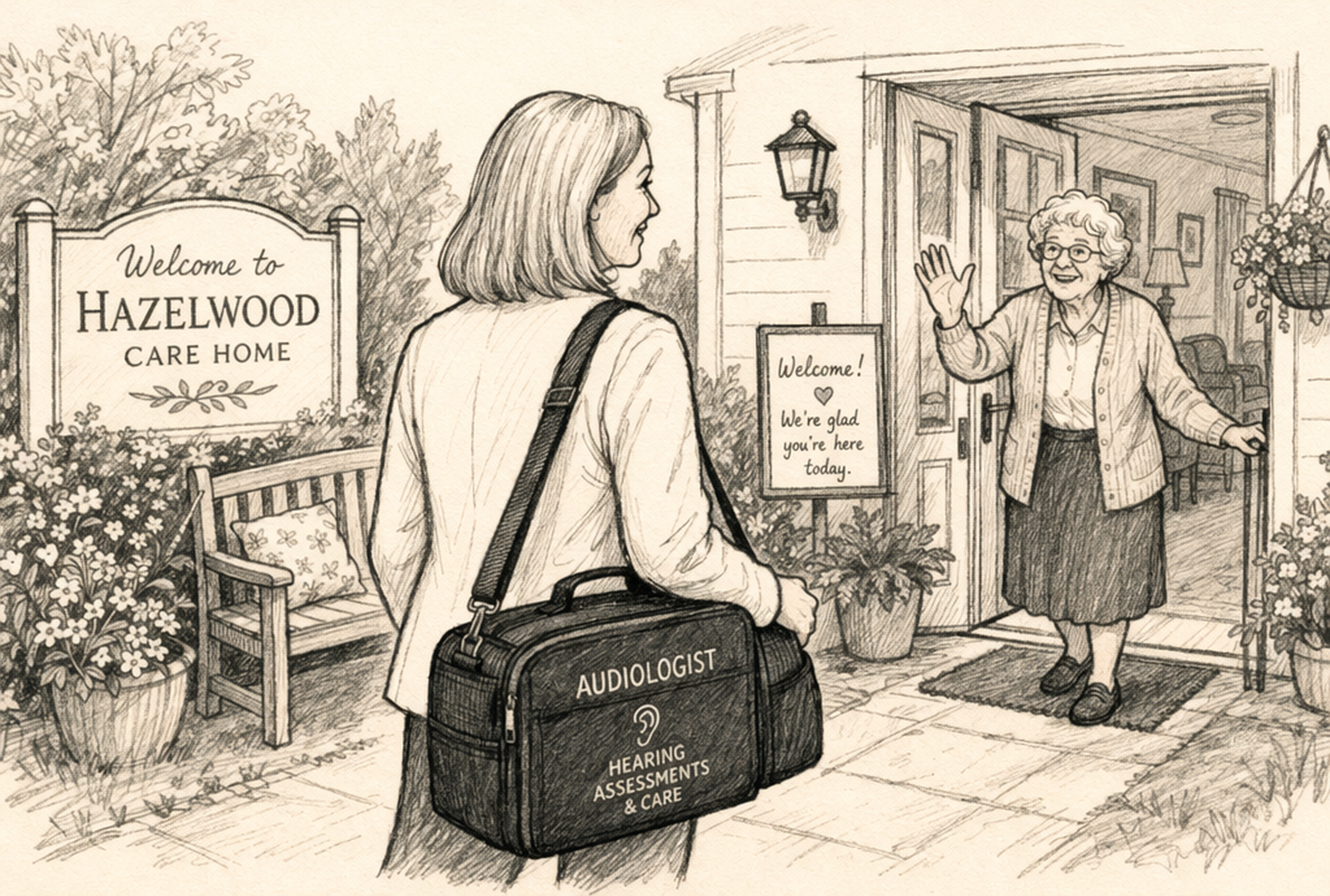
Supporting Residents During a Hearing Test

Hand-sketched illustration of an audiologist arriving at a care home with equipment, showing a welcoming and professional visit.

A calm environment makes a significant difference.

For Care Home Staff
  • Choose a quiet, familiar space
  • Speak clearly and at a natural pace
  • Avoid rushing the process
  • Offer reassurance if needed
For Family Members
  • Attend if possible
  • Encourage without pressure
  • Focus on reassurance rather than correction

The aim is to make the experience comfortable, not clinical.

Home Visit Hearing Tests: A Practical Approach

Transporting residents to clinics can be difficult.

Home visit hearing tests remove this challenge.

They offer:

  • Familiar surroundings
  • Reduced stress
  • Flexible scheduling
  • Personalised attention

For many residents, this is the most appropriate option.

Addressing Emotional Concerns

Some residents may feel uncertain about hearing tests.

Common concerns include:

  • Fear of hearing loss confirmation
  • Worry about needing hearing aids
  • Discomfort with change

It is helpful to explain:

  • A hearing test is simply an assessment
  • It provides information, not obligation
  • Support is tailored to individual comfort

Reassurance is key.

How Often Should Care Home Residents Have Hearing Tests?

General guidance:

  • Every 1–2 years for routine checks
  • Sooner if changes are noticed
  • More frequently if hearing aids are used

Consistency allows changes to be monitored gradually.
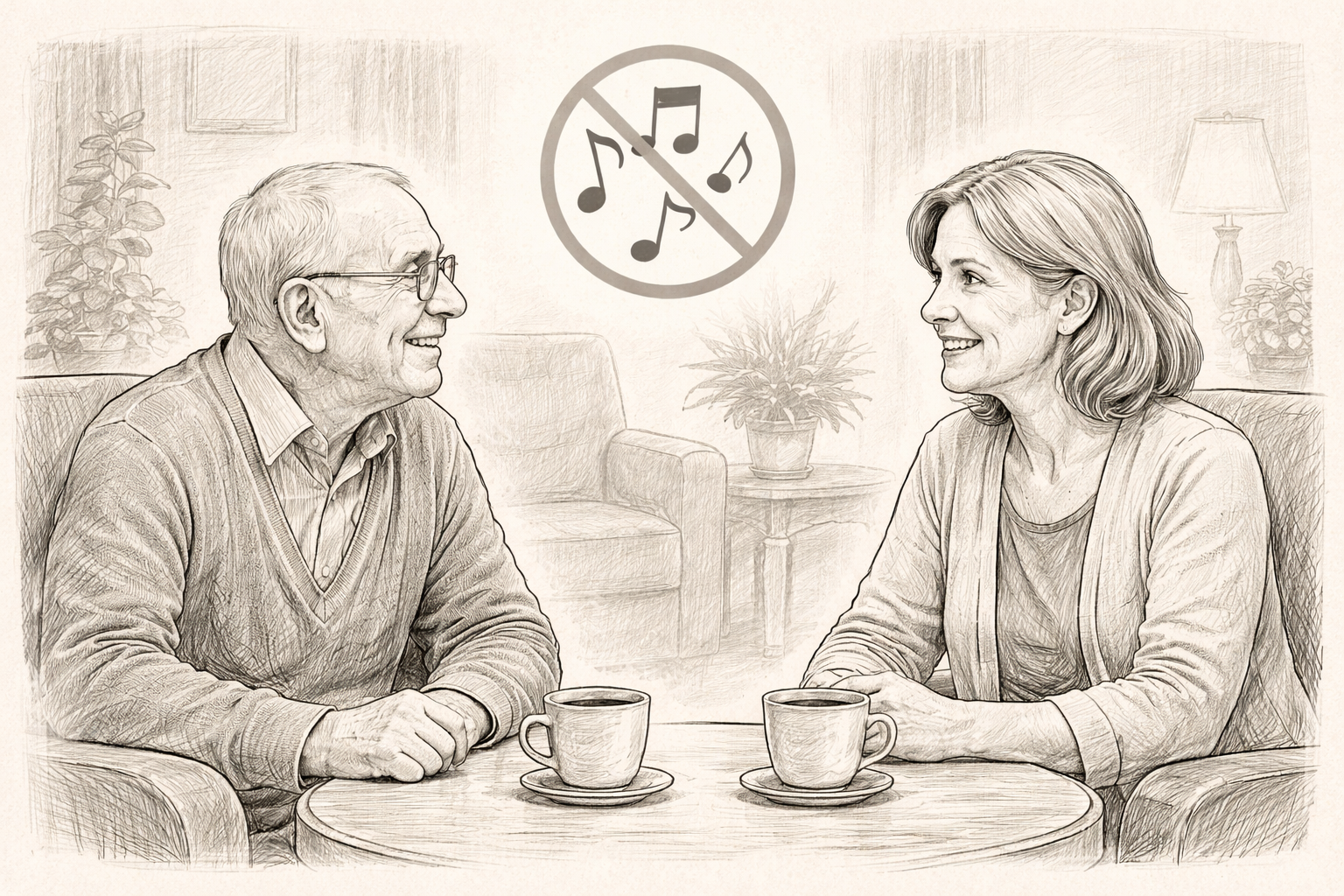
Communication Tips for Residents with Hearing Changes

Hand-drawn illustration of two people talking face-to-face in a quiet room, showing clear communication and reduced background noise.

While awaiting assessment or support, small adjustments can help.

Speak Clearly, Not Loudly

Shouting can distort speech.

Instead:

  • Speak at a steady pace
  • Face the resident
  • Use natural tone
Reduce Background Noise

Turn off:

  • Television
  • Radios
  • Competing conversations

This improves clarity.

Use Visual Cues

Facial expressions and gestures support understanding.

Be Patient

Allow time for responses.

Avoid interrupting or finishing sentences.

Frequently Asked Questions

Are hearing tests safe for elderly residents?

Yes. Hearing tests are non-invasive and designed to be comfortable.

How long does a hearing test take?

Typically between 45 and 90 minutes, depending on the individual.

What if a resident cannot respond clearly?

The audiologist adapts the approach. Testing can be adjusted to suit communication ability.

Can hearing be improved without hearing aids?

In some cases, yes. For example, earwax removal may restore hearing clarity.

Do all residents need regular hearing tests?

Routine checks are beneficial, particularly as hearing changes can be gradual.

Are home hearing tests accurate?

Yes. Portable equipment provides reliable results comparable to clinic testing.

Final Thoughts

Hearing care in care homes is not about intervention.

It is about understanding.

Small changes in hearing can affect communication, confidence and daily life. These changes are often subtle, but they are measurable.

A hearing test provides clarity.

It allows residents to remain:

  • Connected
  • Engaged
  • Supported

In a familiar environment, with a calm approach, hearing assessment becomes a simple and valuable part of care.

Not urgent.
Not complicated.
Just considered, appropriate support.

Complete Hearing Care Near You
We provide professional earwax removal, accurate hearing tests, and expert hearing aid services all in one place. Our experienced team is here to help you hear clearly, comfortably, and with confidence.
Read about our privacy policy.
Thank you! Your submission has been received!
Oops! Something went wrong while submitting the form.

Struggling with Your Hearing? We're Here to Help.

Struggling with your hearing? We offer safe, professional earwax removal across the Midlands — with home visits in Leamington Spa, Nottingham, Leicester, Dudley, Peterborough, Corby, Coventry, and Nuneaton.

A English young man point at book an appointment