

Earwax is part of normal ear health.
It protects the ear canal, traps dust and helps prevent infection. In most cases, it clears naturally without any need for intervention.
However, there are times when earwax builds up and becomes impacted.
When this happens, it can begin to affect hearing, comfort and everyday communication. The change is often gradual, which means it is easy to overlook at first.
For many people in Coventry, the idea of visiting a clinic for earwax removal can feel inconvenient or unnecessary.
Travel, waiting times and unfamiliar environments can make a simple issue feel more complicated than it needs to be.
Home visit earwax removal offers a different approach.
It allows safe, professional care to take place in the comfort of your own home, without the need to travel or adjust to a clinical setting.
This guide explains what earwax build-up means, how home removal works in Coventry and why many people now choose this method over traditional clinic visits.
.png)
Earwax, also known as cerumen, is produced naturally by the body.
It plays an important role in keeping the ear healthy by protecting the ear canal and preventing debris from reaching deeper structures.
In most situations, earwax moves outward naturally and does not require removal.
However, in some cases, this process changes.
Wax may become harder, drier or more difficult to clear. It may begin to collect within the ear canal instead of moving out.
This is when it becomes impacted.
Several factors can contribute to this.
The shape of the ear canal can influence how wax moves. Narrow or curved canals may make natural clearance more difficult.
The use of hearing aids or earphones can also affect the movement of wax.
Attempts to clean the ears using cotton buds often push wax deeper rather than removing it.
Age can also play a role, as earwax tends to become drier over time.
These factors are common and do not indicate anything unusual.
They simply explain why earwax build-up occurs more frequently for some people than others.
The symptoms of impacted earwax are often subtle.
They tend to develop gradually rather than appearing suddenly.
You may notice that sounds feel slightly muted or less clear than usual. Conversations may require more focus. Television volume may increase over time.
Some people describe a feeling of fullness in the ear, as though something is blocking it.
Others may experience mild discomfort or occasional itching.
In some cases, there may be ringing in the ear.
These changes are not always immediately linked to earwax, which is why they are sometimes overlooked.
A simple assessment can usually confirm whether wax is the cause.
Across Coventry, more people are choosing home-based ear care services.
This is not simply about convenience.
It is about creating a more comfortable and accessible experience.
A home visit removes the need to travel across the city. For many individuals, particularly older adults, this is an important consideration.
Appointments can be arranged at a time that suits you, without the need to wait in a clinic environment.
Being at home also changes how the experience feels.
The setting is familiar. The pace is calm. There is no sense of urgency.
This often makes the process more comfortable, particularly for those who feel uncertain about ear procedures.
Home visits also allow family members to be present if needed, providing reassurance and support.

The process of earwax removal at home is structured, but it is not rushed.
It begins with a conversation.
The audiologist will ask about your symptoms and any changes you have noticed in your hearing.
This helps to build a clear understanding before any procedure begins.
The ears are then examined using a small, handheld device.
This allows the audiologist to see whether earwax is present and to assess its position and consistency.
If removal is appropriate, the method used is usually microsuction.
Microsuction is a gentle and controlled technique that removes wax using a small suction device.
It does not involve water and is widely used in professional settings.
The process is carried out carefully and at a pace that feels comfortable.
Most people find it straightforward.
After the removal, the ear is checked again to ensure it is clear.
The audiologist may also provide advice on ear care and whether any follow-up is needed.
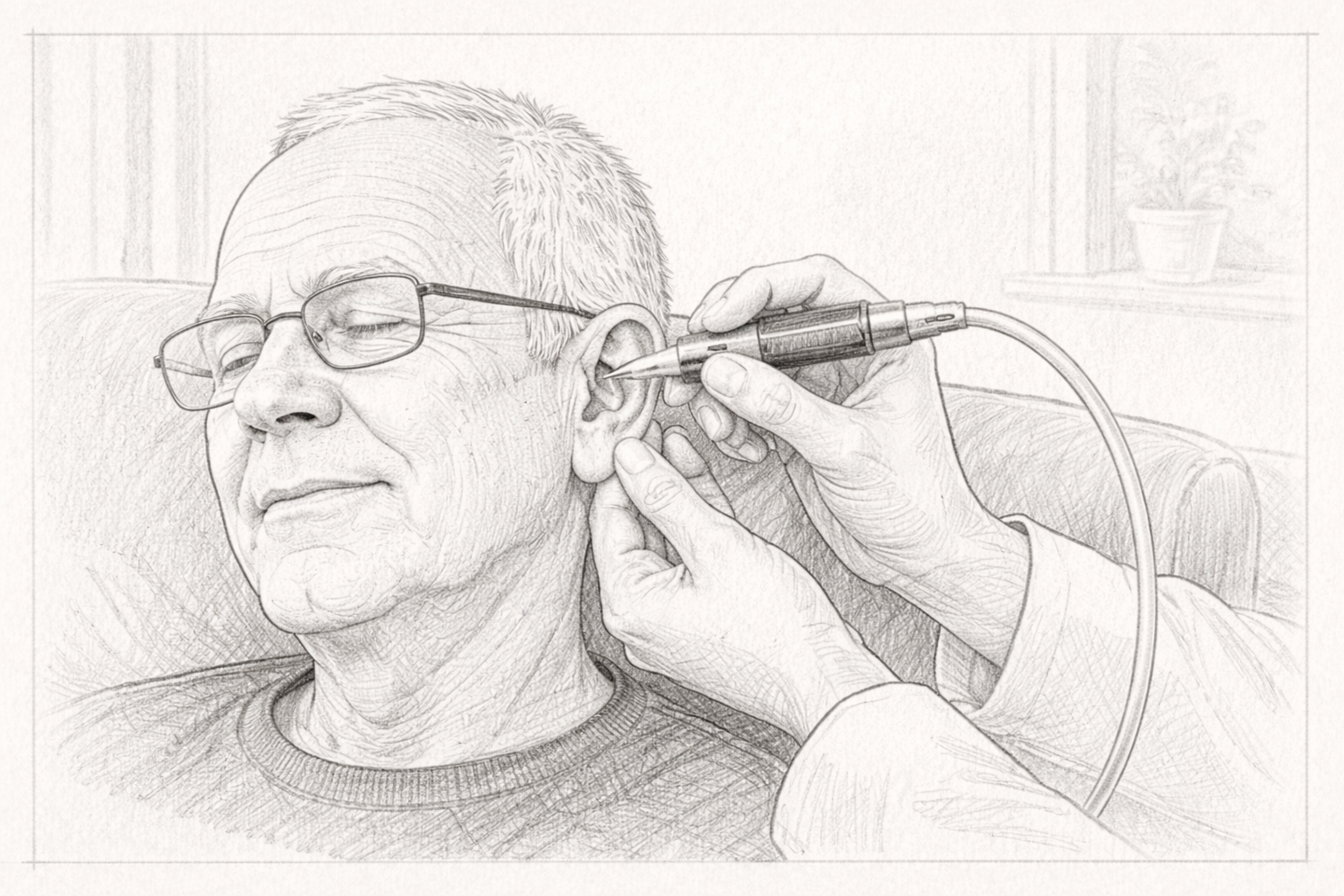
One of the most common concerns is whether earwax removal will be uncomfortable.
In most cases, it is not.
You may notice a soft suction sound during the procedure.
There may be a slight sensation as the wax is removed, but this is usually mild.
The process is designed to be gentle and controlled.
Many people feel immediate relief once the wax has been cleared.
Sounds often become clearer straight away.
Clinic-based earwax removal remains a suitable option for many people.
However, the experience differs from home care.
In a clinic, appointments may be time-limited. There may be waiting periods before and after the visit.
The environment is unfamiliar, which can make some people feel less at ease.
At home, the experience is more personal.
There is no travel. No waiting room. No need to adjust to a different setting.
The appointment takes place in a familiar environment, which often makes communication easier and the overall experience more relaxed.
This difference is why many people in Coventry now prefer home visits.

Home visit earwax removal is suitable for a wide range of individuals.
It is particularly helpful for older adults who may prefer to remain in a familiar environment.
It is also beneficial for people who find travel difficult or tiring.
Care home residents can receive support without leaving their surroundings, which helps maintain routine and comfort.
Hearing aid users may also benefit from regular checks, as earwax can affect how devices perform.
However, home visits are not limited to specific groups.
Anyone who values a calm and convenient approach to care can benefit.
It is important to understand that earwax can affect hearing in ways that are often mistaken for hearing loss.
When wax blocks the ear canal, sound cannot travel as clearly.
This can make hearing feel reduced, even though the underlying hearing ability has not changed.
Once the wax is removed, hearing often improves.
This is why assessment is always the first step.
It ensures that the cause is correctly identified before any further decisions are made.
Many people attempt to manage earwax themselves.
This is understandable, but it can sometimes make the situation worse.
Using cotton buds often pushes wax deeper into the ear.
Other objects can irritate the ear canal or cause injury.
It is generally best to avoid inserting anything into the ear.
Professional removal ensures that the process is safe and effective.
After earwax removal, the ear usually returns to its normal state quickly.
There is no need for complex aftercare.
It is helpful to avoid inserting objects into the ear and to allow the ear to maintain its natural cleaning process.
Some individuals may experience recurring build-up.
In these cases, occasional checks can help prevent symptoms from returning.
Earwax removal is often part of a broader approach to hearing care.
If hearing concerns remain after removal, a hearing test may be recommended.
Home hearing care services in Coventry often combine these elements, allowing assessment and support to take place in one visit if needed.
This creates a more complete and convenient experience.
Most providers offer coverage across Coventry and nearby areas.
Appointments typically last between thirty and sixty minutes, depending on individual needs.
Yes. It is a widely used and controlled method of earwax removal.
Many people notice clearer hearing straight away after removal.
Yes. Many people find it helpful to have someone with them during the appointment.
The audiologist will explain the findings and advise on the next steps if needed.
Earwax build-up is common.
It is also manageable.
Home visit earwax removal in Coventry provides a simple, comfortable alternative to clinic-based care.
It allows the process to take place in a familiar setting, at a pace that feels appropriate.
The experience is calm.
The approach is clear.
The outcome is often immediate.
Hearing should feel natural.
When it changes, even slightly, it is worth understanding why.
Not urgently.
Not with concern.
But with the right support, delivered in the place you feel most comfortable.