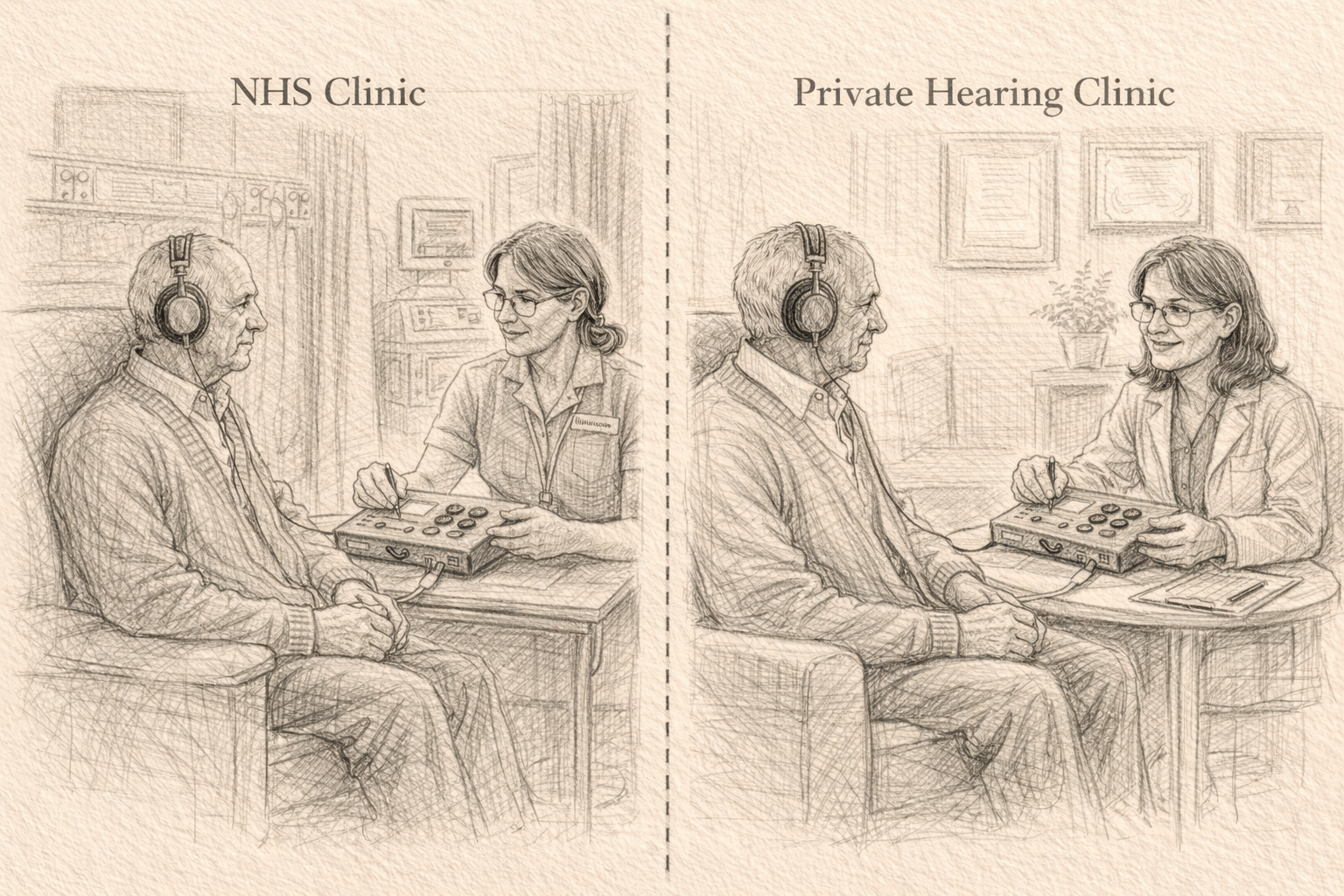
If you think your hearing has changed maybe conversations feel muffled, you’re asking people to repeat themselves, or background noise is suddenly exhausting your next step is usually a hearing test. In the UK, you’ve got two main routes:
NHS hearing assessment (free), typically accessed via GP referral or (in some areas) audiology self-referral.
Private hearing assessment, offered by high-street providers and independent audiology clinics, sometimes free and sometimes paid, often with faster access.
They can look similar on the surface (headphones, beeps, a chart), but the pathway, waiting times, choice of devices, and follow-up model can differ a lot. This guide breaks it down so you can decide what fits your situation.
Important: If you have sudden hearing loss or hearing that worsens rapidly, treat it as urgent. NICE recommends immediate/urgent referral for sudden onset (over 3 days or less) within the past 30 days.
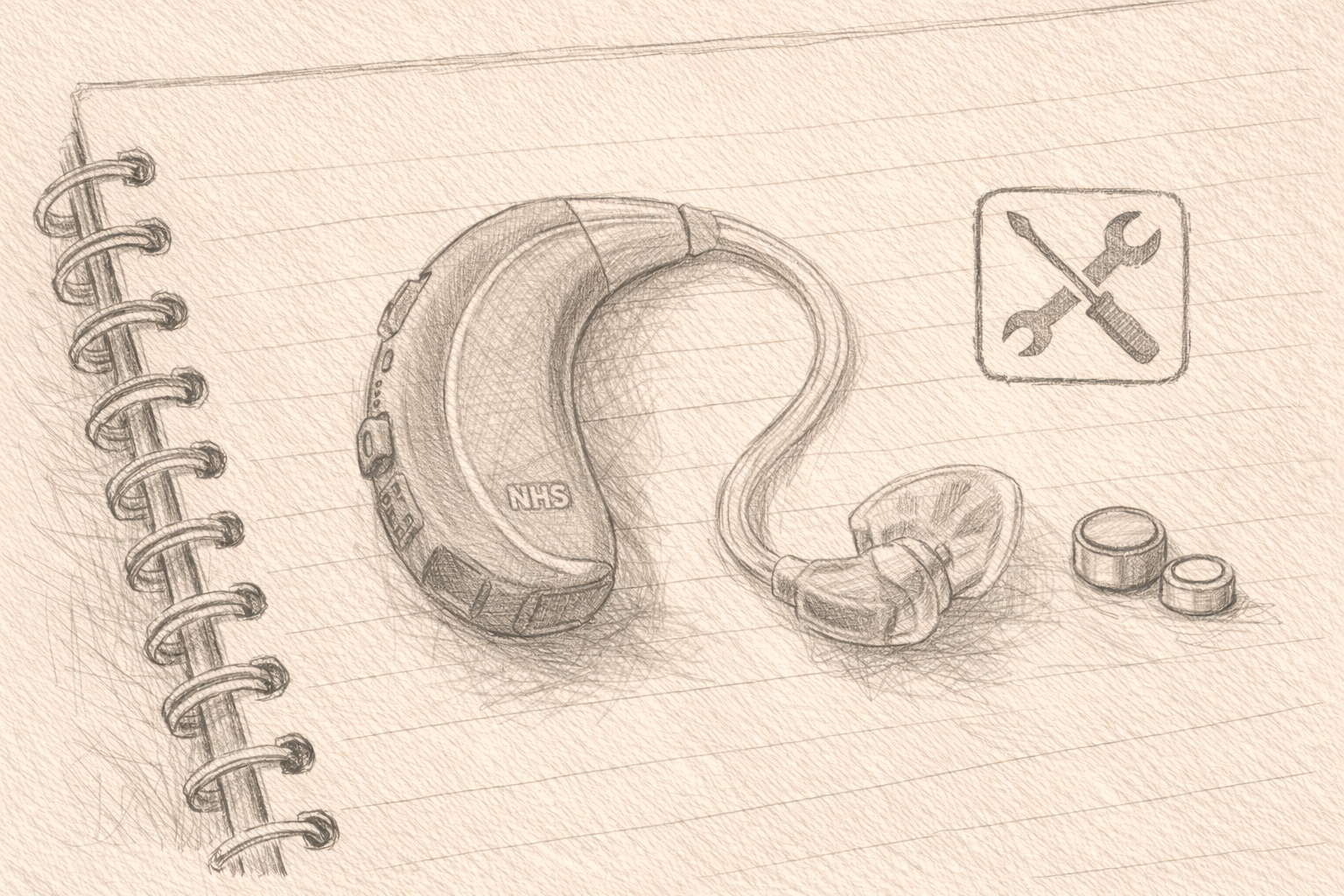
If hearing aids are recommended, NHS hearing aids are provided free as a long-term loan, with free batteries, repairs and follow-up/aftercare (charges can apply if lost/damaged).
Private
A private hearing test may be free or paid, depending on provider and depth of testing.
Some guides cite typical paid ranges for a diagnostic test with an audiologist (and optional follow-up).
If hearing aids are recommended and you choose private devices, you pay for devices and (sometimes) ongoing service packages.
2) Speed and access
NHS
Access is usually via GP referral, though some areas offer self-referral for hearing tests, expanded under NHS England’s access plans.
Waiting times vary by location and service pressure. NHS waiting-time rules and targets exist, but real-world waits differ.
Private
Often quicker appointments (sometimes within days), with flexible evening/weekend slots, depending on provider capacity.
3) What’s included in the assessment
Both routes can include:
Pure tone audiometry (beeps through headphones)
Speech testing
Tympanometry (checks eardrum movement / middle ear function)
Hearing aids are provided based on clinical need and local service options. They’re generally modern digital devices, commonly behind-the-ear styles, and include structured follow-up/aftercare.
Private
Wider menu of styles/brands and add-on features (and sometimes shorter upgrade cycles), but you’re paying for that flexibility.
What happens in an NHS hearing test?
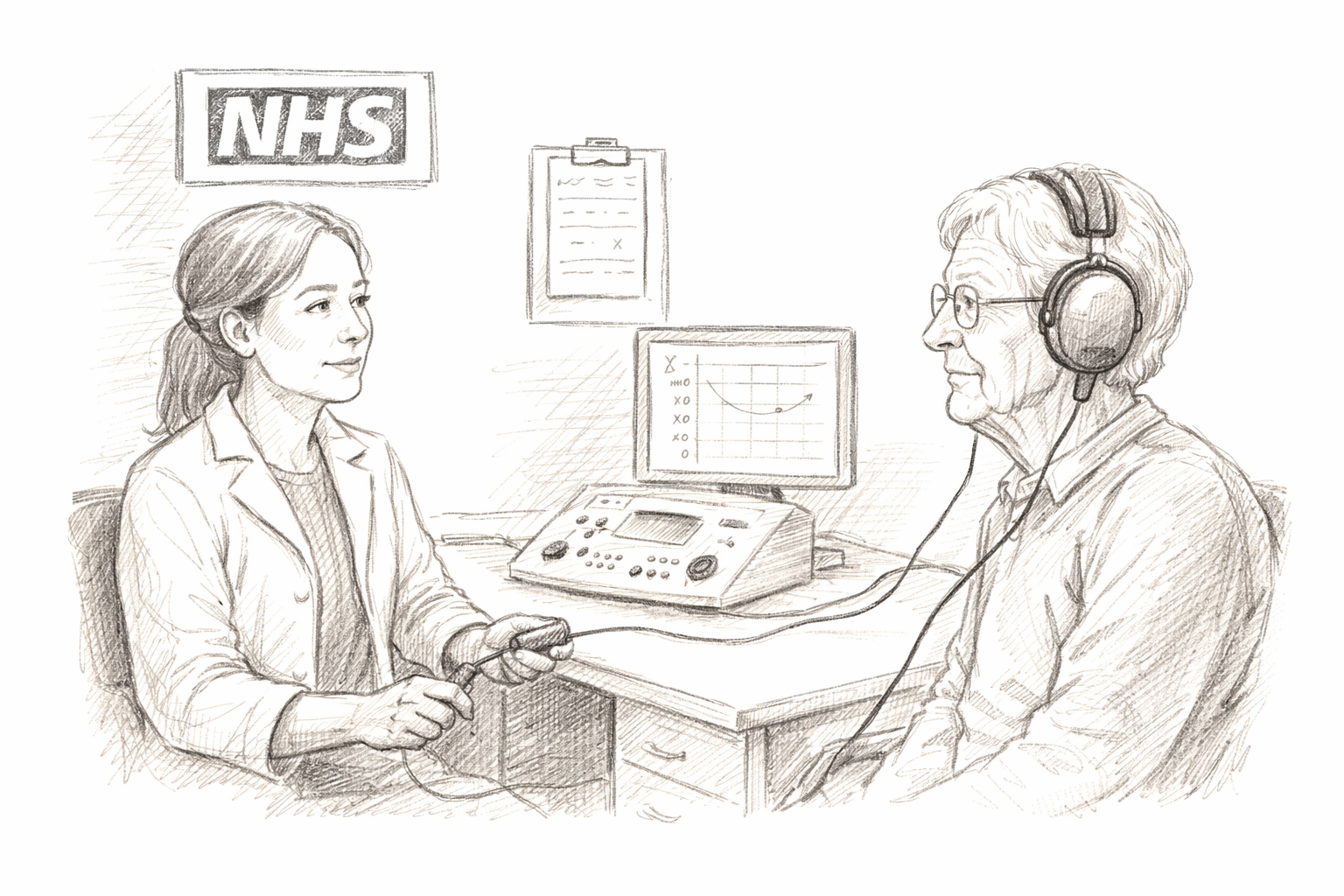
The NHS describes hearing tests as being done by a hearing specialist (audiologist) in a hospital/clinic—or sometimes in a pharmacy/optician setting and typically lasting 15 minutes to 1 hour, depending on which tests are used.
Common NHS tests include:
Pure tone audiometry: You respond when you hear tones at different pitches and volumes.
Speech audiometry: Similar approach but with speech sounds/words to assess clarity.
Tympanometry: A small device measures eardrum movement and can flag middle-ear issues.
The NHS pathway (typical)
You notice a problem (TV volume creeping up, missing words, fatigue in group conversations).
GP visit (or local self-referral if your region offers it). Your GP may refer you to audiology.
Audiology appointment (tests + discussion).
Results and next steps
If your hearing is within expected range: you may get reassurance, monitoring advice, and ear-health guidance.
If hearing loss is identified: you may be offered hearing aids, communication strategies, and follow-ups.
NHS hearing aids: what you get (and what’s included)
NHS hearing aids are:
Free as a long-term loan
Include free batteries and repairs
Include follow-up appointments and aftercare (replacement charges may apply if lost/damaged).
This long-term support is a big deal. Hearing aids aren’t “fit once and forget” your brain needs time, settings can need tweaks, and real-life listening needs change.
What happens in a private hearing test?
Private tests are broadly similar in core diagnostics but may differ in time, pace, and add-ons.
Typical private appointment flow
Case history + goals
Where are you struggling: restaurants, phone calls, meetings, TV, family conversations?
Ear health check
Many providers use otoscopy or video otoscopy to check for earwax and visible issues (varies by clinic).
Pure tone + speech + middle-ear checks are common components.
Results + recommendations
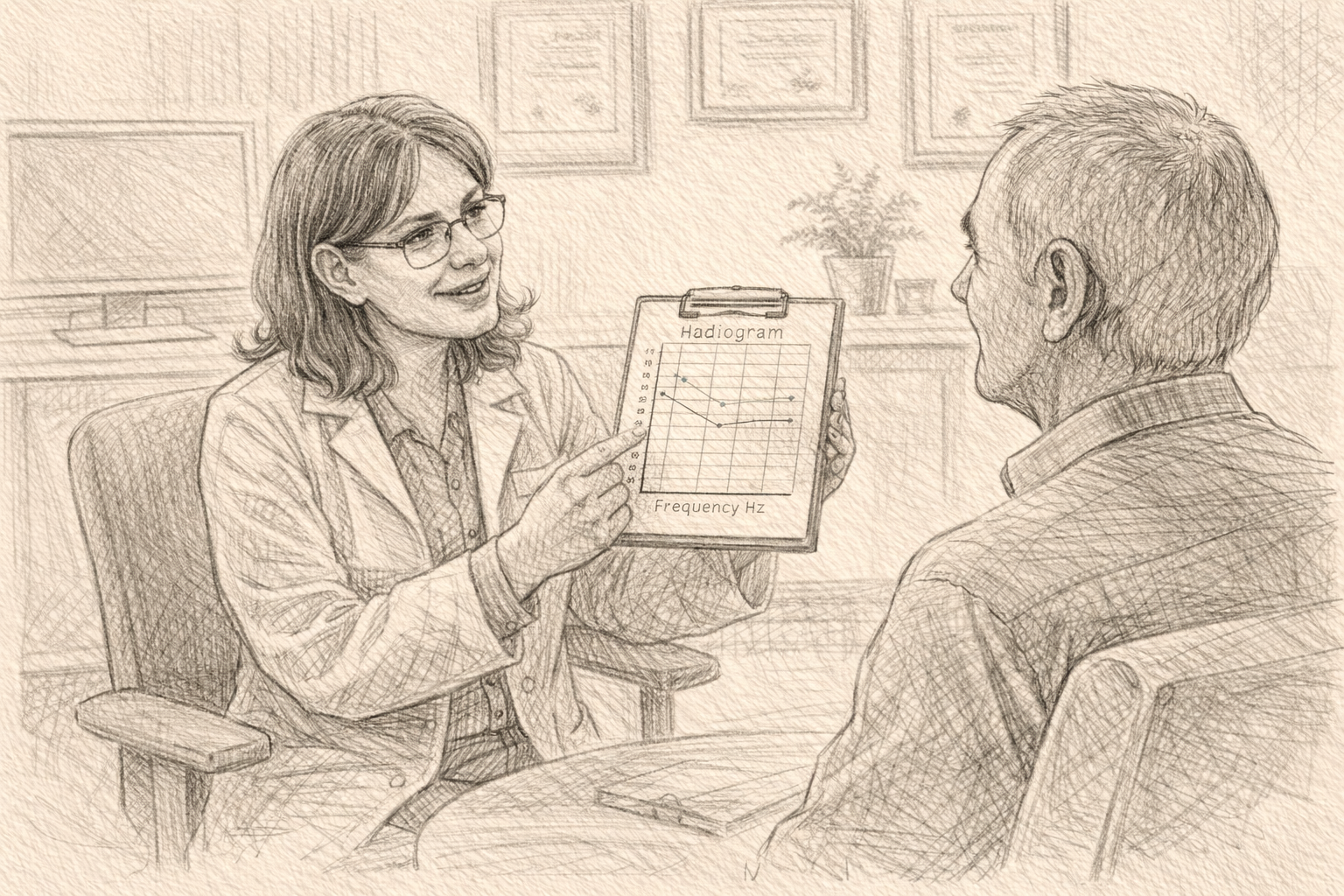
You’ll usually get an audiogram and explanation.
If hearing aids are suggested, you’ll be shown options, prices, and service plans.
Private pricing: what to expect
Pricing varies heavily by provider and how the test is positioned (screening vs full diagnostic). Some private providers advertise free, longer assessments (often as part of a broader hearing-care service). Other sources describe typical paid ranges for different levels of private testing.
A useful way to think about it:
Free tests are often comprehensive, but the business model may assume some people will later purchase devices.
Paid tests can be a good option if you want a test-only appointment with minimal sales pressure, or if you’re seeking a second opinion.
Key differences that matter in real life
1) Waiting times and convenience
If you’re struggling day-to-day work meetings, caring responsibilities, loneliness speed can matter.
NHS waits vary by region and service demand, with national targets/frameworks but different local realities.
Private clinics often offer faster booking and more appointment times.
Tip: If you go private for speed, you can still keep the NHS route open for longer-term support and device provision (depending on your situation and preference).
2) Device choice: “good” vs “more choice”
This is where many people feel the biggest difference.
NHS hearing aids
Modern digital aids are available and fitted based on hearing loss and needs.
The specific models/styles can vary by local service and contracts, and some services focus on particular types/styles (e.g., common behind-the-ear options).
Private hearing aids
More brands and styles (including more cosmetic options), and sometimes more advanced features are available to choose from if you’re willing to pay.
But here’s the crucial point: fit and follow-up often matter as much as the device itself. A “perfect” hearing aid that isn’t well fitted, explained, and fine-tuned can underperform. A “simpler” device fitted thoughtfully can be life-changing.
This isn’t a dig at either route it’s just different structures.
The NHS is set up to assess, treat, and refer when medically needed guided by clinical criteria and referral standards (including urgent referral advice for sudden hearing changes).
The private sector is often set up for customer experience: rapid access, longer consults, broad choice, and convenience.
Which one should you choose?
Choose NHS if…
Cost is a major factor (tests, hearing aids, batteries, repairs and follow-ups are covered).
You want long-term care without worrying about service packages.
Your hearing needs are straightforward and you’re happy with the NHS device range.
Choose private if…
You want the quickest route to an appointment.
You want maximum choice of hearing aid styles/features.
You value longer appointments, extra counselling time, and more flexible follow-ups.
Consider a hybrid approach if…
You want a fast private test now, but prefer NHS provision and aftercare longer-term.
You want a second opinion on your audiogram and options.
You want private devices but still want an NHS ENT pathway if any red flags appear.
Red flags: when to seek urgent medical advice
Don’t “wait and see” if you have:
Sudden hearing loss (especially over 3 days or less)
Rapidly worsening hearing in one or both ears
Significant new dizziness, facial weakness, severe ear pain, or discharge
NICE recommends urgent/immediate referral for sudden onset hearing loss within the past 30 days.
What questions should you ask any provider?
Whether NHS or private, these questions help you get a better outcome:
What tests will you do today, and why? (Pure tone, speech testing, tympanometry, speech-in-noise, etc.)
Will I get a copy of my audiogram and results? You should be able to take this away for your records.
What happens next if you find hearing loss? Hearing aids, communication strategies, monitoring, referral.
If hearing aids are recommended, what’s included in aftercare? Visits, repairs, batteries, warranty, replacements.
What’s your approach to fitting and fine-tuning? Best outcomes usually include a few follow-ups.
FAQs
Are NHS hearing tests free?
Yes NHS hearing tests are free, and if hearing aids are provided they’re free as a long-term loan with free batteries, repairs, and follow-up appointments (replacement charges may apply if lost/damaged).
Can I self-refer for an NHS hearing test?
In some areas, yes. NHS England has supported expanding self-referral routes for services including hearing tests, but availability depends on where you live and local service configuration.
What tests are included in a hearing assessment?
The NHS lists common tests including pure tone audiometry, speech audiometry, and tympanometry.
Are private hearing tests better?
Not automatically. Private tests can offer faster access and sometimes longer appointments or extra testing, but NHS audiology uses standard diagnostic methods too. The “best” option is the one that gives you timely care, clear explanations, and good follow-up.
If I go private, can I still use the NHS later?
Often, yes you can still talk to your GP and pursue NHS support if you want. Your private audiogram can be helpful context, but NHS services may repeat tests to confirm results and follow their pathway.
Bottom line
NHS is usually the best-value route for long-term support: free assessment, free hearing aids (loan), and free batteries/repairs/aftercare.
Private is often the fastest and most flexible route: quicker access, more appointment choice, and a wider range of hearing aid options at a cost.
If your hearing changed suddenly, treat it as urgent and seek immediate medical advice.
If you want, tell me your UK nation (England/Scotland/Wales/N. Ireland) and what you’re experiencing (gradual vs sudden, one ear vs both, tinnitus/dizziness or not), and I’ll suggest the most sensible next step and the key questions to take to an appointment.
Complete Hearing Care Near You
We provide professional earwax removal, accurate hearing tests, and expert hearing aid services all in one place. Our experienced team is here to help you hear clearly, comfortably, and with confidence.
Thank you! Your submission has been received!
Oops! Something went wrong while submitting the form.
Struggling with Your Hearing? We're Here to Help.
Struggling with your hearing? We offer safe, professional earwax removal across the Midlands — with home visits in Leamington Spa, Nottingham, Leicester, Dudley, Peterborough, Corby, Coventry, and Nuneaton.