

In brief
Explore practical ways to make hearing assessments accessible, including home appointments, communication support and involvement of carers.
Key takeaways
- A home hearing assessment considers the listening situations that matter to you.
- Your ears are checked before the hearing tests begin.
- Results and practical next steps are explained during the appointment.
How this guide answers your question
Use these points to move from the concern you noticed to a sensible next step.
How Can Hearing Assessments Be Made More Accessible?Hearing changes often happen gradually. Conversations become harder to follow, background noise feels overwhelming, and familiar sounds seem distant or unclear. For many older adults, these changes are easy to dismiss until they begin to affect confidence, independence, and daily life.
For seniors and individuals with mobility issues, booking a hearing test can feel like a challenge in itself. Travelling to clinics, navigating busy waiting rooms, and coping with unfamiliar environments often leads people to delay assessment altogether.
A private hearing test at home removes these barriers. It offers the same professional assessment found in specialist clinics delivered calmly, accurately, and conveniently in the comfort of your own home.
This guide explains why home hearing tests are especially well suited to seniors and those with mobility difficulties, how the process works, and what to expect from a private, home-based hearing assessment across the Midlands.
Why Seniors Often Delay Hearing Tests

Hearing loss is one of the most common age-related health concerns, yet it’s also one of the most frequently delayed.
Common reasons seniors postpone hearing tests include:
- Difficulty travelling to appointments
- Reliance on family or carers for transport
- Anxiety about clinics or medical settings
- Physical fatigue or balance concerns
- Belief that hearing loss is “just part of ageing”
Unfortunately, delaying assessment can lead to increased isolation, frustration, and reduced quality of life.
A private hearing test at home offers a supportive alternative removing many of the practical and emotional barriers that prevent seniors from getting checked.
What Is a Private Hearing Test at Home?

A private hearing test at home is a full audiological assessment carried out by a qualified hearing care professional in the patient’s own home. It uses portable, calibrated equipment to measure hearing levels accurately across different frequencies.
The assessment follows the same clinical standards as a clinic-based test, but with added benefits:
- No travel or waiting rooms
- Familiar surroundings
- Unhurried appointments
- Personalised, one-to-one care
For seniors and those with mobility issues, this setting often leads to a more relaxed and productive assessment.
How Accurate Is a Hearing Test at Home?

Accuracy is a common concern and understandably so. Hearing tests must be reliable to be meaningful.
Modern home hearing tests are highly accurate because:
- Equipment is professionally calibrated
- Testing follows recognised audiology protocols
- Quiet rooms are used for assessment
- Results are interpreted by trained professionals
In many cases, seniors respond better at home due to reduced anxiety, leading to clearer and more reliable results.
A private home hearing test offers accuracy without pressure, which is especially important for elderly patients.
How a Home Hearing Test Works (Step by Step)

A private hearing test at home is carried out at a comfortable pace, with clear explanations throughout.
1. Initial Discussion
The appointment begins with a conversation about hearing concerns, lifestyle, and medical history. This helps provide context for the results.
2. Ear Health Examination
The practitioner checks the ears for wax build-up or other issues that may affect hearing or test accuracy.
3. Hearing Assessment
The patient listens to tones and speech sounds through headphones. Responses are recorded to create a hearing profile.
4. Results Explained Clearly
Results are explained in plain language, avoiding technical jargon.
5. Next Steps Discussed
If hearing loss is identified, options such as monitoring, hearing aids, or further support are discussed with no pressure.
Why Home Hearing Tests Are Ideal for Seniors

For older adults, the environment matters just as much as the test itself.
Key Benefits for Seniors:
- No travel required
Eliminates transport challenges and physical strain. - Familiar surroundings
Helps patients feel relaxed and confident. - Reduced anxiety
No busy waiting rooms or rushed appointments. - Flexible scheduling
Appointments can be arranged around energy levels and routines. - Clear communication
Family members or carers can be present if helpful.
These factors make home hearing tests particularly suitable for seniors and those with limited mobility.
Hearing Tests for People with Mobility Issues

For individuals with mobility difficulties, attending a clinic can be exhausting or impractical.
Home hearing tests remove:
- Stairs and long corridors
- Parking and travel concerns
- Physical fatigue
- Risk of falls
Instead, care is delivered in a controlled, accessible environment making assessment safer and more comfortable.
From Hearing Test to Hearing Aids at Home

If hearing loss is identified, many providers can continue care at home.
This may include:
- Hearing aid recommendations
- Home fitting and adjustment
- Follow-up visits and support
This continuity of care is especially valuable for seniors who benefit from consistency and familiar settings.
Private Hearing Tests vs High-Street Options

Many people compare private home hearing tests with high-street services.
High-street tests:
- Often free
- Retail environment
- Limited time per appointment
- Travel required
- Personal and unhurried
- Conducted at home
- Focused on patient needs
- Ideal for complex situations
For seniors and those with mobility issues, the comfort and clarity of a private home visit often outweigh other considerations.
Areas Covered Across the Midlands

Private home hearing tests are available across:
- Birmingham
- Coventry
- Leicester
- Nottingham
- Wolverhampton
- Derby
As well as surrounding towns and villages throughout the West and East Midlands.
FAQs
Is a hearing test at home reliable?
Yes - equipment and procedures meet professional standards.
How long does a home hearing test take?
Usually 45–60 minutes.
Can family members be present?
Yes, if the patient prefers.
Is a private hearing test better for seniors?
For many, the comfort and clarity make it ideal.
Do home tests include hearing aid advice?
Yes, if appropriate.
Final Thoughts
Hearing loss doesn’t need to be ignored or delayed especially when assessment can take place in the comfort of home.
For seniors and individuals with mobility issues, private hearing tests at home across the Midlands offer accuracy, dignity, and reassurance helping people stay connected to the sounds and conversations that matter most.
For appointment information rather than general guidance, see Arrange a home hearing test. Check current postcode coverage before arranging a visit.
What a home hearing assessment can clarify
A hearing assessment connects everyday listening difficulties with measured results and practical next steps.
| Part of the visit | What it explores | Why it matters |
|---|---|---|
| Conversation and history | Changes, priorities and listening situations | Keeps the assessment relevant to everyday life |
| Ear examination | Visible wax and the condition of the outer ear | Helps identify whether another step is needed first |
| Appropriate hearing tests | Responses to sounds across useful frequencies | Provides results that can be explained and discussed |
Would a hearing assessment help?
Explore private hearing tests carried out at home, with results explained clearly.
Arrange a home hearing test →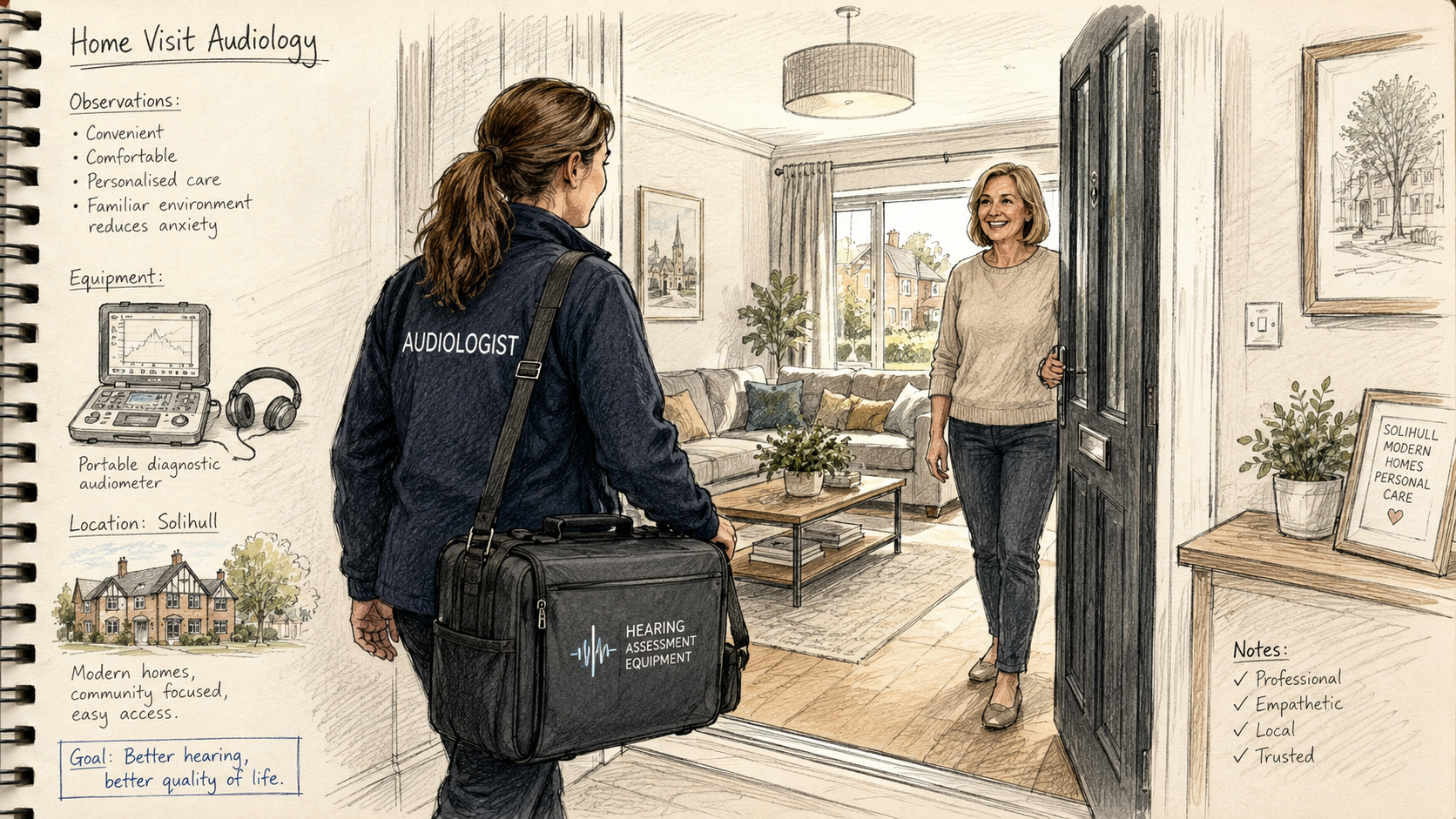 Hearing Test
 Hearing Test
 Hearing Test