
Hearing Aids
8 min read

Home Visit Hearing Aids in the Midlands. Supply, Fit & Aftercare

February 4, 2026
Professional home visit hearing aids across the Midlands. Full hearing tests, expert fitting, and ongoing aftercare all delivered in your own home.
Written by
Rizwan Makda
Published on
February 4, 2026

Choosing hearing aids is not just about technology. It’s about comfort, confidence, and continuity of care.

For many people across the Midlands  particularly older adults, those with mobility challenges, or individuals who feel overwhelmed by clinics  the traditional hearing aid journey can feel difficult. Multiple appointments, travel, waiting rooms, and rushed fittings often create more stress than reassurance.

That’s why home visit hearing aids have become an increasingly preferred option across the West and East Midlands.

A home visit service allows you to receive professional hearing tests, hearing aid supply, expert fitting, and long-term aftercare  all in the comfort and familiarity of your own home.

This guide explains exactly how home visit hearing aids in the Midlands work, who they are best suited for, and why ongoing aftercare is just as important as the hearing aids themselves.

Why More People in the Midlands Are Choosing Home Visit Hearing Aids

Hand-drawn, notebook-style illustration of an elderly couple sitting comfortably at home, smiling with relief as a healthcare professional visits them. The warm home scene emphasizes comfort and convenience. In contrast, a small distant clinic icon shows a long road, a car, and a clock, symbolizing travel and waiting. Sketchy ink lines and soft colors give a research notebook illustration style.

The Midlands has one of the UK’s largest ageing populations, with many people living independently but facing practical challenges when it comes to healthcare access.

Common reasons people choose home visit hearing aids include:

  • Difficulty travelling to clinics
  • Mobility or balance concerns
  • Anxiety in medical environments
  • Lack of local specialist clinics
  • Preference for one-to-one, unhurried care

Home visits remove these barriers entirely.

Instead of fitting hearing aids into your life, the service fits around you.

What Are Home Visit Hearing Aids?

Hand-sketched educational diagram on lined notebook paper illustrating hearing aids delivered and fitted at home. A delivery van points toward a house at the top. Below, a step-by-step flow shows a hearing test with headphones and chart, an in-home fitting with a professional adjusting hearing aids, and ongoing remote support via phone or video call. Simple icons for testing, fitting, and support appear along the bottom. Clean, medical, black-and-white sketch style.

Home visit hearing aids are not a different type of device  they are the same modern, advanced hearing aids you would receive in a clinic, but delivered through a home-based care model.

This includes:

  • A full professional hearing test at home
  • Expert advice on suitable hearing aids
  • Supply of hearing aids tailored to your needs
  • Precise fitting and programming
  • Follow-up visits and long-term aftercare

Everything happens in your home, at your pace.

Areas Covered Across the Midlands

Hand-drawn illustration of a UK Midlands map on lined notebook paper, with simple red location markers highlighting Birmingham, Coventry, Leicester, Nottingham, and Wolverhampton. Surrounding towns, dotted roads, light green countryside shading, and small doodles like buildings, trees, a windmill, and a compass rose give it a casual research-notebook style.

Home visit hearing aid services typically cover a wide range of locations, including:

West Midlands
  • Birmingham
  • Solihull
  • Wolverhampton
  • Walsall
  • Dudley
  • West Bromwich
  • Sutton Coldfield
  • Stourbridge
  • Halesowen
East Midlands
  • Coventry
  • Leicester
  • Nottingham
  • Derby
  • Loughborough
  • Hinckley
  • Nuneaton
Surrounding Towns & Villages

Home visits are particularly valuable in smaller towns and rural villages where access to audiology clinics may be limited.

If you live outside a major city, home visit hearing aids often provide better access to specialist care, not less.

Step 1: Home Hearing Test – The Foundation of Everything

Hand-sketched, black-and-white notebook-style illustration of a calm in-home hearing test: a clinician sits beside a patient wearing headphones and holding a response button, using a portable audiometer. The patient is seated comfortably in a quiet living-room setting with a chair, window, and plant. Handwritten labels and a small audiogram chart emphasize the medical, instructional sketch style.

Every successful hearing aid fitting starts with an accurate hearing assessment.

A home hearing test includes:

  • Detailed discussion about your hearing concerns
  • Ear health examination (including earwax check)
  • Professional hearing assessment using portable clinical equipment
  • Clear explanation of results in plain language

This step ensures that any hearing aid recommendation is based on real listening needs, not assumptions.

Importantly, many hearing difficulties are worsened or even caused by earwax. Identifying this early prevents unnecessary hearing aid use.

Step 2: Choosing the Right Hearing Aids (Not Just the Most Advanced)

Hand-sketched, black-and-white notebook-style illustration of a calm in-home hearing test: a clinician sits beside a patient wearing headphones and holding a response button, using a portable audiometer. The patient is seated comfortably in a quiet living-room setting with a chair, window, and plant. Handwritten labels and a small audiogram chart emphasize the medical, instructional sketch style.

Hearing aids are not one-size-fits-all.

A good home visit audiologist will consider:

  • Your hearing test results
  • Your lifestyle and daily environments
  • Manual dexterity and vision
  • Previous hearing aid experience
  • Personal preferences and comfort

Common Types of Hearing Aids Supplied at Home

Hand-drawn, notebook-style illustration comparing two healthcare pathways. On the left, the “NHS Clinic Pathway” shows a referral leading to a crowded waiting room with a clock (long wait), limited choice of clinician, and a clinic visit. On the right, the “Private Home Visit Pathway” shows a referral leading to a clinician arriving at a house, emphasising home visits, personal choice, and comfort at home. Icons at the bottom highlight waiting time (hourglass), choice (signpost), and comfort (armchair with a drink).
  • Behind-the-ear (BTE) hearing aids
  • Receiver-in-canal (RIC) hearing aids
  • Discreet or near-invisible hearing aids
  • Rechargeable hearing aids
  • Bluetooth-enabled hearing aids

The goal is not to sell the “best” hearing aid  but the most appropriate one.

Private Hearing Aids vs NHS Hearing Aids

Many people in the Midlands ask whether to choose NHS or private hearing aids.

NHS Hearing Aids
  • Free of charge
  • Limited choice of models
  • Longer waiting times
  • Clinic-based fitting only
Private Hearing Aids (Home Visit)
  • Wider range of modern technology
  • Faster access
  • Home-based care
  • Personalised fitting and aftercare

For many, private home visit hearing aids offer greater flexibility, comfort, and long-term support.

Step 3: Professional Hearing Aid Fitting at Home

Hand-drawn, medical notebook–style illustration of an audiologist carefully fitting and adjusting a hearing aid on an older patient in their home. The audiologist works slowly and attentively while the patient sits calmly, focused on the process. Sketchy ink lines, soft colour washes, and notebook details like a checklist, pen, and coffee cup emphasize a relaxed, unhurried, and personalized in-home care experience

Hearing aid fitting is one of the most critical steps and one of the most commonly rushed in clinics.

A home visit hearing aid fitting allows:

  • More time for fine adjustments
  • Real-world listening checks in your home environment
  • Calm explanations without pressure
  • Immediate feedback from the wearer

During fitting, the audiologist:

  • Programmes the hearing aids precisely to your hearing levels
  • Adjusts sound for comfort and clarity
  • Ensures physical fit is comfortable and secure
  • Teaches you how to insert, remove, and maintain the aids

This process cannot be rushed and at home, it doesn’t have to be.
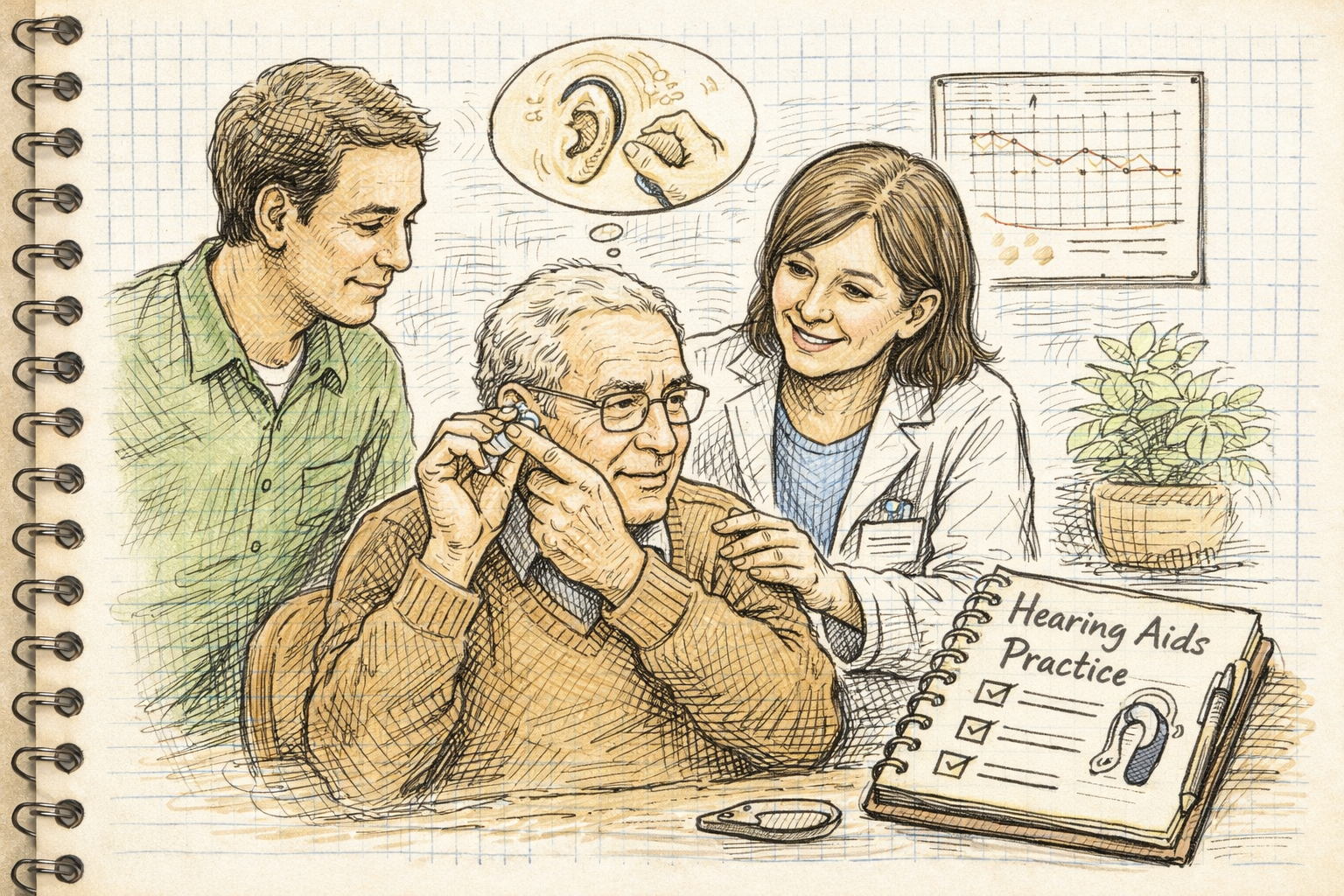
Step 4: Learning to Use Hearing Aids with Confidence

New hearing aids take time to adjust to.

Home visits provide space to:

  • Ask questions
  • Practise handling
  • Learn cleaning and charging routines
  • Understand realistic expectations

Many people benefit from having a family member or carer present during this stage, which is far easier at home than in a clinic.

Why Aftercare Matters More Than the Hearing Aids Themselves

Hearing aids are not “fit and forget” devices.

Your hearing, comfort, and listening environments change over time. Without aftercare, even the best hearing aids can become ineffective.

Quality Aftercare Includes:
  • Follow-up adjustments
  • Hearing aid cleaning and checks
  • Ear health monitoring
  • Ongoing advice and support
  • Future hearing tests

Home visit aftercare ensures that support remains accessible especially as mobility needs change.

Home Visit Hearing Aid Aftercare in the Midlands

Aftercare delivered at home is particularly valuable for:

  • Elderly patients
  • Hearing aid users with dexterity issues
  • Care home residents
  • Patients with progressive hearing loss

Rather than struggling to attend appointments, support comes to you  ensuring hearing aids continue to help, not frustrate.

Hearing Aids for Elderly Patients at Home

Older adults often benefit most from home visit hearing aids.

Advantages include:

  • Familiar surroundings reduce anxiety
  • No travel or fatigue
  • Slower, clearer explanations
  • Carers can be involved

This approach often leads to better long-term hearing aid use, not abandonment.

Hearing Aids and Earwax Management

Earwax is one of the most common reasons hearing aids stop working properly.

Regular professional ear checks at home allow:

  • Early detection of wax build-up
  • Safe removal if needed
  • Improved hearing aid performance
  • Reduced risk of feedback or blockage

This is an essential part of responsible hearing aid aftercare.

Are Home Visit Hearing Aids as Accurate as Clinic Fittings?

Yes.

When delivered by a qualified audiologist using professional equipment, home visit hearing aid fitting is just as accurate as clinic-based care.

In many cases, it’s more effective because:

  • The environment is quieter and calmer
  • The audiologist has more time
  • Adjustments are based on real-world listening

How Long Does the Home Visit Hearing Aid Process Take?

The process is spread over several visits:

  • Initial hearing test: 45–60 minutes
  • Hearing aid fitting: 60–90 minutes
  • Follow-up visits: 30–60 minutes

This phased approach allows gradual adjustment and better outcomes.

Who Is Home Visit Hearing Aid Care Best For?

Home visit hearing aids are ideal for:

  • Adults over 60
  • People with mobility or health conditions
  • Hearing aid users seeking better support
  • Care home residents
  • Family members organising care for loved ones

Common Concerns About Home Visit Hearing Aids

“Will I be pressured to buy?”

No. Ethical providers focus on assessment and advice first.

“Are home visits more expensive?”

Costs are often comparable to clinic services when aftercare is included.

“Can modern hearing aids really be fitted at home?”

Yes — portable technology allows full programming and verification.

The Long-Term Benefits of Home Visit Hearing Aids

Patients who choose home visit hearing aids often report:

  • Better hearing aid comfort
  • Higher daily usage
  • Fewer problems over time
  • Greater confidence in conversations
  • Stronger ongoing support

Final Thoughts: Hearing Care That Comes to You

Hand-sketched, warm pencil notebook–style illustration of an audiologist leaving a patient’s home after a visit. The patient stands at the doorway smiling and waving, relaxed and confident, while the audiologist waves back as she departs. Soft pencil lines, gentle colour washes, and notebook details like a checklist and coffee cup convey trust, continuity of care, and a reassuring end to an in-home appointment

Hearing aids are not just devices they are part of an ongoing care relationship.

For many people across the Midlands, home visit hearing aids offer the most practical, comfortable, and effective way to manage hearing loss.

From initial assessment to fitting and long-term aftercare, receiving professional hearing care at home removes barriers, reduces stress, and leads to better outcomes.

If you or a loved one are considering hearing aids, choosing a home visit service may be the most supportive decision you can make.

Complete Hearing Care Near You
We provide professional earwax removal, accurate hearing tests, and expert hearing aid services all in one place. Our experienced team is here to help you hear clearly, comfortably, and with confidence.
Read about our privacy policy.
Thank you! Your submission has been received!
Oops! Something went wrong while submitting the form.

Struggling with Your Hearing? We're Here to Help.

Struggling with your hearing? We offer safe, professional earwax removal across the Midlands — with home visits in Leamington Spa, Nottingham, Leicester, Dudley, Peterborough, Corby, Coventry, and Nuneaton.

A English young man point at book an appointment